Timeline
Every post and feed across this instance
-
#525 – IA, données, cybersécurité : les nouvelles menaces
Episode 525 avec Thierry, Sébastien S. et Pierre
Sommaire
- C comme CHUV : Quand un hôpital développe une IA pour les incidents critiques. (00:01:19) un assistant IA destiné à analyser les événements indésirables signalés Sources ictjournal.ch, chuv.ch et wp.unil.ch.
- E comme Elastique : L'élasticité qui a tout changé. (00:09:28) Les 20 ans d'Amazon EC2: la naissance du cloud computing. Sources aws.amazon.com et aws.amazon.com.
- F comme Fuite : A qui le tour ? (00:16:50) Les fuites de données, une routine française. Sources bonjourlafuite.eu.org, frenchbreaches.com et secnumacademie.gouv.fr.
- L comme Le Meilleur du Podcast : Quand un chroniqueur fait de la promo pour du Podcast. (00:32:25) Seconde édition de l'événement Le Meilleur du Podcast, parlons audience et plateformes Sources lemeilleurdupodcast.ch et cominmag.ch.
- L comme Liquidation : Quand les données se vendent comme des meubles. (00:41:21) Google, Spirit Airlines et la ruée sur les données d'entreprise. Sources theregister.com et storage.courtlistener.com.
- P comme Photo : Pas de photo sans appareil. (00:52:31) Votre visage est déjà dans une base de données que vous ne connaissez pas. Sources malwarebytes.com, claritycheck.com et pimeyes.com.
- S comme Suisse : Quand la Suisse consommera suisse. (01:02:58) Et si la Suisse privilégiait ses propres entreprises tech pour ses achats de services numériques ? Sources combourse.com et letemps.ch.
- U comme Unifiée : Faire tourner un LLM chez soi en 2026. (01:15:45) Pourquoi la mémoire unifiée lancée par Apple écrase les GPU ? Sources theregister.com, nvidia.com et wendy.dev.
- Y comme Yaris : Cape d'invisibilité. (01:25:44) Attaque par exemples contradictoires. Sources korben.info, lacremedugaming.fr et flocksafety.com.
Toutes les informations pour vous abonner au podcast et à l'infolettre : 🌐 lestechnos.be
op3.dev -
New Update: Radar RSS v0.0.6 (Beta) — Comprehensive Light Theme Polish & UI Refinements 🎨
Radar RSS v0.0.6-beta delivers complete Light Theme optimization across all UI components, fixing contrast and illegibility issues, and refining color palettes and borders.
https://github.com/dznass-cmd/RadarRSS/releases/tag/v0.0.6-beta
submitted by /u/Significant-Flan5228
[link] [comments] -
A Doctor’s Gut Reset: 4-Part Protocol to Stop Bloating, Boost Energy, & Feel Better Now
Why are you bloated all the time?
Why can certain foods suddenly make you feel terrible?
And what is actually going on inside your gut when nothing you try seems to work?
Today, Mel is joined by Dr. Rajsree Nambudripad, MD, a board-certified medical doctor specializing in integrative gut health and integrative medicine, who has spent years helping patients uncover what’s really behind their most stubborn symptoms.
This conversation will change the way you understand your gut – and reveal a simple 4-part protocol for getting to the root of what’s making you feel so bad so you can feel your best again.
Dr. Rajsree covers it all: IBS, bloating, SIBO, constipation, diarrhea, leaky gut, histamine intolerance, low stomach acid, reflux, food sensitivities, and more.
And she explains the surprising ways your gut can impact your energy, anxiety, focus, sleep, skin, weight, metabolism, blood sugar, and thyroid health.
You’ll learn:
-The 4 systems that control your gut health – and what happens when even one is out of balance
-2 steps you can start taking immediately to improve your gut health
-What causes bloating and how to stop it fast
-The 3 main symptoms of IBS and what they may be telling you
-What histamine intolerance is and how it disrupts your “gut garden”
-The surprising connection between your gut and your thyroid
-The Hashimoto’s symptoms your gut may reveal first
-How exercise can help reverse insulin resistance
-Why your “acid reflux” may actually be the opposite problem
If you’ve been told “everything looks normal” but you still don’t feel normal – or you’re tired of guessing which food, supplement, or symptom to chase next – this episode will help you understand what your body may be trying to tell you – and what to do next.
For more resources related to today’s episode, click here for the podcast episode page.
If you liked this episode, listen to this one next: #1 Dermatologist: The Ultimate Skincare Routine for Amazing Skin.
Mel wants to add:
- Try the 23g protein shot I drink every single morning
- Join 2 million readers loving my weekly newsletter - full of tips, tools, and inspiration
- The Let Them Theory: read the book everyone’s talking about
- Watch the episodes on YouTube
- Connect with me on Instagram
- Follow the show’s Instagram for clips, behind the scenes, and more
- Find some daily positivity on my TikTok
- Want zero ads? Subscribe to SiriusXM Podcasts+ to listen to new episodes ad-free
- Disclaimer
Hosted by Simplecast, an AdsWizz company. See pcm.adswizz.com for information about our collection and use of personal data for advertising.
dts.podtrac.com -
Broken feeds for newspapers owned by MediaNews Group?
San Francisco Bay area newspapers owned by MediaNews Group (East Bay Times, Mercury News, Marin Independent Journal) have for a long time published RSS feeds for various sections of their sites. For example, the source code for the Mercury News homepage currently includes the following link to an article feed:
<link rel="alternate" type="application/rss+xml" title="The Mercury News » Feed" href="https://www.mercurynews.com/feed/" />My feed reader software indicates that these feeds all quit working on March 9th. When I try to load any of them directly in my browser, I get an
HTTP 403error.Does anyone know what happened and how we might get them to fix it? I tried contacting them via a form but never heard back.
submitted by /u/lxmvrmpl
[link] [comments] -
Claude Code is like Victor Wembanyama, assuming you follow the NBA and are interested in first hand experience with CC as a programming partner for the last 8 months or so.
-
Understanding ChatGPT Work
OpenAI announced ChatGPT Work on July 9th, and have been furiously iterating on it ever since. It is an extraordinarily confusing and very powerful product. Here's what I've figured out about it so far.
ChatGPT Work is actually two products
The more interesting version of ChatGPT Work is the one that runs in the cloud. This can be accessed via chatgpt.com or through the ChatGPT mobile apps. Let's call it Work Cloud.
If you install the ChatGPT desktop app - the app that used to be called Codex - you gain access to a thing called ChatGPT Work that can access files and run programs directly on your computer. Let's call that one Work Local. This one feels more like regular Codex re-skinned to be less intimidating to non-software-developers.
(Update: Work Cloud is also available from the ChatGPT desktop app, via a Where should this chat run? dropdown.)
For the rest of this article I'm going to talk exclusively about Work Cloud.
Work is for paid subscribers only
Right now, ChatGPT Work (in both flavors) is available only to $20/month and up subscribers. Free users and $8/month Go users do not have access.
Work has features that aren't available in Chat
The interface for accessing Work is a tab selector, which presents it as an alternative to Chat:

The obvious question is when should I use Chat, and when should I use Work?
OpenAI's official answer to that question is:
Use Chat when you want an answer, explanation, brainstorm, or short draft. Use ChatGPT Work when you want ChatGPT to complete a task with a clear outcome, such as a brief, deck, analysis, recurring update, workflow, or file you can review and use.
I find that almost entirely useless, because I've been using regular ChatGPT Chat for all of those task categories for years!
The better question then is what features does Work have that are missing from Chat?
After extensive experimentation I think I've mostly figured that out:
- Options to use Luna and Terra in place of Sol
- A code execution environment with Internet access
- A headless Chrome browser
- A persistent filesystem shared between sessions
- The ability to publish ChatGPT Sites
- The ability to run sub-agent sessions with Sol, Luna, and Terra
- Scheduled prompt automations (may be in ChatGPT Chat too)
Model selection
In Work, you get the option to pick GPT-5.6 Sol, Luna, or Terra, each with Light, Medium, High, Extra High, Max, or Ultra reasoning levels. You can also pick GPT-5.5 at Light, Medium, High, or Extra High.
These look to be the same models that are available through the OpenAI API.
Chat offers a different selection: 5.6 Instant, Medium, High, Extra High, and Pro (actually Extra High and Pro are only available for $100/month+ subscribers - $20/month subscribers cap out at High). It doesn't explain if those are Luna or Terra or Sol (I'm assuming Sol?). 5.6 Pro appears to be exclusive to Chat, with no equivalent in Work.
My current understanding from using Codex is that Ultra is a special mode that more eagerly delegates to sub-agents.
I believe ChatGPT Work sessions are billed against your Codex allowance, while ChatGPT Chat Sessions get their own, separate allowance. This may help explain the model availability differences.
Code execution with Internet access!
As a long-time fan of the Code Interpreter pattern - pioneered by OpenAI in 2023 - this is by far the most exciting feature of ChatGPT Work (Cloud) for me.
The code execution environment can now talk to the rest of the internet!
ChatGPT Chat can't do this - if you ask it to install additional software packages or interact with websites or APIs that access will be blocked by the container proxy.
(Weirdly, back in January it grew the ability to install packages, but that doesn't seem to work any more. I wish they had better changelogs!)
Claude's equivalent container has allowed restricted internet access since it launched last September. Claude can install packages from PYPI and NPM and clone repositories from GitHub. But that is about it: the allowlist of domains is very short.
ChatGPT Work allows a whole lot more than that. It can be configured with a specific list of allowed domains, but the default appears to be open to all.
This makes Work an incredibly useful tool. You can have it clone GitHub repositories, install their dependencies, then use them to interact with the rest of the web!
A full, headless Chrome browser
Another killer feature of ChatGPT Work is the browser tool. ChatGPT Work can launch a full Chrome instance, load websites, fill out forms, and take screenshots.
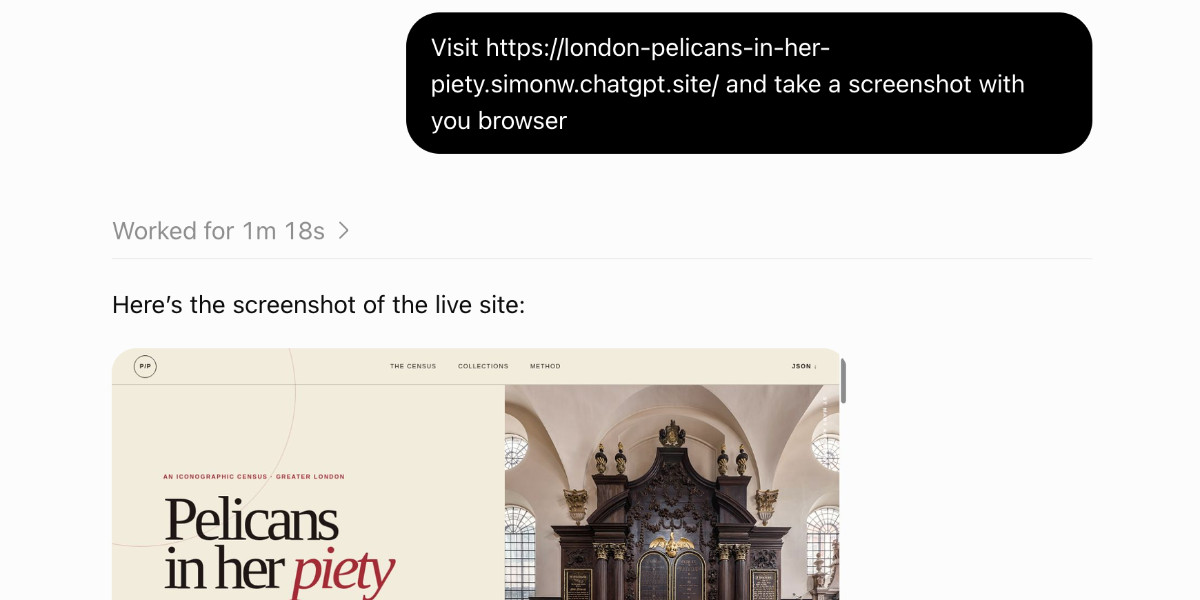
If a site requires sign in the browser can prompt you to take over and enter both passwords and 2FA codes, without round-tripping those credentials through the model itself.
It can even run JavaScript against the DOM of loaded pages. I prompted:
Load simonwillison.net in your browser and extract the headings using JavaScriptChatGPT Work fired up a browser instance and ran the code:
await tab.playwright.evaluate(() => {
  return Array.from(document.querySelectorAll("h1,h2,h3,h4,h5,h6"), heading => ({
    level: heading.tagName.toLowerCase(),
    text: heading.innerText.trim().replace(/\s+/g, " "),
    id: heading.id || null
  }));
});
This feels a lot like my shot-scraper javascript tool, only now I can access it on my phone!
A persistent, shared filesystem
ChatGPT Chat gets a fresh filesystem for each chat session. These cannot be accessed from any other session.
In ChatGPT Work each session gets its own scratch folder - named something like
/workspace/scratch/e00a0a017944- but each of those are persisted across sessions, so you can access files from previous chats. I have 171 folders in/workspace/scratchright now!As far as I can tell that
/workspacevolume is mounted to all Work sessions that are currently running - file edits from one can be instantly seen by the others. They don't seem to share the same process space though, and localhost servers running in one can't be accessed from another.ChatGPT Sites
ChatGPT Work has the ability to build and deploy entire websites, using Cloudflare Workers. These can have HTML and JavaScript and can run server-side features too, including stateful features on top of Cloudflare D1 and R2.
Here's a simple site I built with this feature:
london-pelicans-in-her-piety.simonw.chatgpt.site

My prompt was:
Figure out all of the places in London with a pelican in her piety, then turn that into a JSON file and build a ChatGPT sites site about them(A pelican in her piety is a fascinating piece of medieval Christian imagery - once you know about them you'll find them all over the place.)
These sites default to being private to the user that created them, but you can make them public and (on team plans) share them with other specific individuals.
Sub-agents with Sol, Luna, and Terra
There's not much to say about this one. ChatGPT Chat can't run sub-agents. ChatGPT Work can. This is very much a power-user feature: if you are running a complex project that can benefit from multiple parallel agents working together, Work can do that.
Scheduled prompt automations
Another feature that seems to have migrated from regular ChatGPT to ChatGPT Work at some point. You can prompt ChatGPT Work like this:
run a search to see if Waymo have announced a launch date for Half Moon Bay every day at 8amThis will schedule a prompt to run on that frequency. These prompts can decide that nothing interesting has happened, or they can decide to notify you of some new information.
Update: Actually this seems to work in ChatGPT Chat as well.
It's still worth noting here though, as it can be used in conjunction with other ChatGPT Work exclusive features. You can set a scheduled task to update a ChatGPT Site on an hourly basis, for example.
Is this safe?
An open question for me right now is how safe all of this stuff is.
My lethal trifecta model warns about the risks inherent in any agent system that combines access to private data with exposure to untrusted content and a way to communicate stolen information back to an attacker.
ChatGPT Work combines all three!
I'd love to hear more from OpenAI about how they protect ChatGPT Work sessions against prompt injection attacks. I expect their answer is the same auto-review mechanism as Codex.
OpenAI could make this a lot less confusing
Figuring this all out took way more work than it should have.
I think there are two key problems here:
- OpenAI explain Work in terms of what it's for, not what it actually does
- OpenAI still insist on hiding their system prompts and tools descriptions
If the ChatGPT Work documentation included the exact system prompt and tool descriptions used by the agent I wouldn't have needed to write this post.
A list of all the tools
Shortly after publishing this article I had an idea. I started a fresh Work session and prompted:
Build a site that lists every one of your tools - nearly grouped into categories - and for each one explain what it does. Try to exactly duplicate arguments and tool descriptions where possible. Design aesthetic should be technical docs, minimal flareHere's the site it built, which includes details of 223 registered tools - though 6 of those are from my own personal MCPs served via datasette-mcp.
And a whole lot of Skills
I noticed that the only browser-related tool in the list was web.run, which has methods for running searches, opening URLs, and clicking links, but didn't look like the full story in regards to headless browser automation.
This made me suspicious that something was missing, so I told the ChatGPT Work session that built that tools reference site:
Add full copies of every skill to the website (separate pages linked to from the homepage)It turns out ChatGPT Work uses a lot of skills - 44 in fact!
The control-browser skill explains how the browser works:
Run browser setup code through the Node REPL
jstool. In this environment the callable tool id typically appears asmcp__node_repl__js. [...]The ability to interact directly with the browser is exposed through the
browser-clientruntime via theagent.browsers.*API. Before trying to interact with it, you MUST emit and read the complete documentation returned byawait browser.documentation()in one go.So I told Work:
Add the full output of await browser.documentation() to the bottom of the /skills/control-browser page
And now you can read that on /skills/control-browser as well.
A few more interesting Skills:
-
documents for creating
.docxfiles -
imagegen with tips on creating images with the
image_gentool - pdf for both reading and rendering PDFs
-
Spreadsheets for manipulating
.xlsx,.xls,.csv,.tsv - sites:sites-building for creating ChatGPT Sites
- openai-docs for answering questions about itself
- data-analytics:build-dashboard for building data dashboards
You are only seeing the long-form articles from my blog. Subscribe to /atom/everything/ to get all of my posts, or take a look at my other subscription options.
-
Goliad State Park. Finally getting back to my state park quest. Summer is too hot, but I’m testing a new portable air conditioner.
-
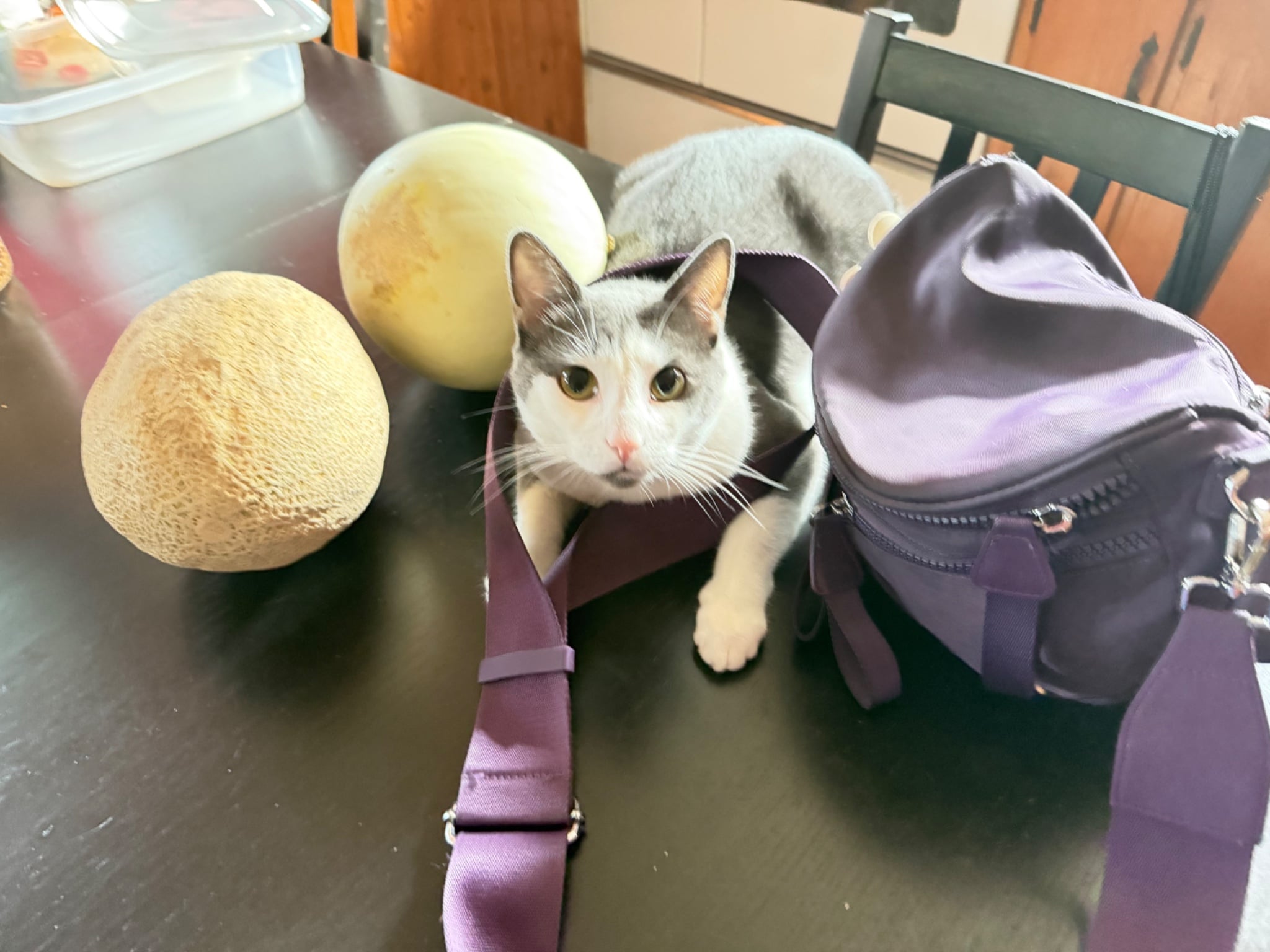
Myles wants to go too
-
How Taylor Sheridan's Fever Dreams Explain MAGA Foreign Policy (with SecDef Rock)
Samantha and the pseudonymous commentator Secretary of Defense Rock talk "Lioness," "Sicario," and the broader Taylor Sheridan-verse as a Rosetta stone for untangling right-wing policy from the border to Venezuela to drones.
anchor.fm -
So far so good
-
County courthouse in Lockhart.
-
1899 - "Asymmetric Intimacy"
No Agenda Episode 1899 - "Asymmetric Intimacy"
Asymmetric Intimacy"
Executive Producers:
Stuart Greene
Jessica Greene
Sir Sala Hauser
Sir Ty of God's Flat Earth
Eric Wilka
Dr. Sir OneAwesome Jason PhD.
Tom Beben
Katherine Nicholas
Sir JoFo
Peter Bickford
Raymond Lee (switcheroo from Indy NA Meetup)
Indy NA Meetup
The Sydney No Agenda Meetup Mob — Sir Chris Wilson
Associate Executive Producers:
Manuka Gold Family — manukagold.com (code TREASURE)
Eli The Coffee Guy — Gigawatt Coffee Roasters (code ITM20)
Annette Miller (switcheroo from Indy NA Meetup)
Indy NA Meetup
Linda Lupatkin — Imagemakers Ink, Duchess of Jobs
Knights and Dames:
Stuart Greene > Sir Troubleshooter
Raymond Lee > Sir Raymond
Jessica Greene > Dame Doula at your Cervix
Annette Miller > Dame Near Perfect
Order of the Ant:
Stuart Greene
Jessica Greene
Sir Sala Hauser
Sir Ty of God's Flat Earth
Eric Wilka
Dr. Sir OneAwesome Jason PhD.
Tom Beben
Katherine Nicholas
Sir JoFo
Peter Bickford
Raymond Lee
End of Show Mixes:
Jus Baker (Where's The Beef)
Jus Baker (All-In Jason Calacanis)
Jus Baker (The Biggest Oil Deal)
Mark van Dijk - Systems Master
Ryan Bemrose - Program Director
Back Office Jae Dvorak
Chapters: Dreb Scott
Clip Custodian: Neal Jones
Clip Collectors: Steve Jones & Dave Ackerman
Last Modified 08/30/2026 15:55:34 by Freedom Controllerop3.dev -
Funniest/Most Insightful Comments Of The Week At Techdirt
This week, MrWilson scores another double-win with both top spots on the insightful side. In first place, it’s a piece-by-piece response to a commenter who defended ICE’s failed illegal raid on an immigration law office: In second place, it’s a comment about the first two measles deaths of 2026: Then: “Nobody has died. It’s not […] -
New Update : Radar RSS v0.0.5 (Beta) — Instant Launch, Universal Image Engine & Gesture Navigation
What's New in v0.0.5
⚡ Instant App Startup (< 50ms)
- Offline-First Stale-While-Revalidate Engine: Articles and headlines are now cached in local persistent storage, enabling immediate paint upon launch with zero blank screens or perceived network delays.
- Instant Electron Window Launch: BrowserWindow displays in under 30ms with dark theme (
#0a0b0e) to eliminate white flashes.
👈👉 Fluid Swipe Story Navigation
- Horizontal Swipe Gestures: In the Story Reader modal, swipe Left-to-Right or Right-to-Left (or use keyboard arrows / UI buttons) to seamlessly flip through stories with smooth slide animations and haptic feedback.
🖼️ Universal RSS Image Loading & Layout Previews
https://github.com/dznass-cmd/RadarRSS/releases/tag/v0.0.5
submitted by /u/Significant-Flan5228
[link] [comments] -
The AS/400 Revolution: “The System is the Solution” 🖥️ The AS/400 (introduced i...
The AS/400 Revolution: “The System is the Solution” 🖥️
The AS/400 (introduced in 1988) was revolutionary because it was one of the first systems to integrate the hardware, operating system, and database into a single box — way before that became a common concept. IBM’s “The System is the Solution” campaign was one of the most successful in computing history, and the platform lasted so long that it was rebranded as IBM i in 2008, yet still actively used in thousands of businesses worldwide in the 2020s.
Even more impressive? RPG, which was created in the 1960s, is still in active use today — making it one of the longest continuously used programming languages in history. Many companies still rely on RPG programs written 30-40 years ago that continue to run flawlessly on IBM i systems.
-
Successful launch of NASA's Nancy Grace Roman Space Telescope:
Roman pairs a large field of view with crisp infrared vision to explore vast swaths of the sky and probe deeply into cosmic history. This flagship mission will help astronomers explore dark matter, dark energy, and worlds outside of our solar system, known as exoplanets.
🚀
-
RSSMonster – An agentic RSS reader built on local embeddings and small models
Article URL: https://github.com/pietheinstrengholt/rssmonster/
Comments URL: https://news.ycombinator.com/item?id=49498634
Points: 2
# Comments: 1
-
Google's Calling Lake Ontario 'Lake America' Now
Google Maps announced on Saturday it would start reflecting the change for U.S.-based users. -
 I've been watching Season 1 of The Pitt, and as its reviews said, it's great drama, and there are lots of episodes. I like shows like this because they're simulated communities, we come to know the characters, and think about them even when we're not watching. Before too long we'll have AI programming that makes these shows like software, the stories assemble around the characters, and then are generated the same way ChatGPT generates the art we call slop, which will someday not be a pejorative the same way sick and junk aren't negative terms today. So we'll be able to call up new episodes of The Wire or The Sopranos or The Pitt any time we like. We'd be missing the fun of discussing the latest episode with friends, or maybe we'll have bot-invented friends too who will simulate having watched the episode you just watched, which leads us to another masterpiece of entertainment, The Matrix. On the other hand, I've watched The Wire at least five times all the way through, and even though I know what they're about to say in a lot of places, I do forget the sub-plots so at least some of it can be new each time. And btw, finally an episode of Silo that's was surprising that I didn't see coming. I read the books, so I feel like I should watch the show, but until the latest episode I was uninterested in any of the characters. Finally there's a plot to think about!
 -
Obama's Campaign Manager's 2028 Scouting Report
Jon sits down with legendary Democratic strategist David Plouffe to assess the race for the Senate and House and — why not? — look forward to 2028. The two talk through the new roster of early primary states and the political dynamics at play in each, and then do some (very) early handicapping of the rumored '28 contenders, from Kamala Harris to AOC and Jon Ossoff.
Hate listening to ads? Become a Friends of the Pod subscriber for ad-free episodes of Pod Save America, Pod Save the World, Lovett or Leave It, Runaway Country, Offline with Jon Favreau, and more—plus exclusive content, including bonus episodes of Pod Save America. Subscribe now at crooked.com/friends, on Apple Podcasts, or through the Pod Save America YouTube channel.
You can request a transcript by emailing transcripts@crooked.com. Include the podcast name, episode title, and air date. Please allow 48 hours for delivery.
clrtpod.com -
RadarRSS Update: Improved AI curation, refined UI, and new features based on your feedback!
Hey r/rss!
A few days ago, I posted here introducing RadarRSS—an open-source, AI-curated modern news dashboard aimed at reimagining how we consume RSS feeds.
Thanks to the valuable feedback and discussion on my previous post, I just pushed a new release with several improvements to make the experience cleaner, faster, and more practical:
Refined Dashboard UI: Polished the feed layout to minimize clutter and give a true "modern newsroom" feel instead of a plain feed list.
Smarter AI Curation & Summaries: Fine-tuned the AI categorization and summarization layer to highlight key takeaways faster and reduce redundant articles.
Better Feed Organization: Enhanced auto-tagging and filtering so you can easily track high-priority topics across multiple feeds.
Performance & Stability Tweaks: Optimized feed fetching and overall responsiveness.
The goal is still to build a lightweight, open-source alternative for anyone looking for something more dynamic than traditional readers like FreshRSS, Miniflux, or Feedly.
🔗 Release & Source Code: https://github.com/dznass-cmd/RadarRSS
Would love to hear your thoughts on these updates—especially regarding the layout and AI curation flow. Any suggestions on what to tackle next?
submitted by /u/Significant-Flan5228
[link] [comments] -
Watched: Coyote vs. Acme. So much fun. They nailed it. 🍿
-
👁️ TIL that a kiwi driver’s license can be digitized on your phone - but that doesn’t mean that it will be accepted by the other party.
-
An absolutely delicious temperate cloud-free day in the Catskills, so I got up from the computer and enjoyed.
-
Trump’s Third Term May Not Need Trump
There are at least two obvious ways to imagine Donald Trump trying to remain president after 2028.
The first is the constitutional loophole: someone close to him — perhaps one of his children — runs for president with Trump as vice president, wins, then resigns. The 22nd Amendment says Trump cannot be elected president a third time; whether that also makes him constitutionally ineligible to become president through succession has never been definitively settled.
The second is more dramatic: war, perhaps an escalating ground war with Iran, becomes the justification for emergency powers, disruption of the 2028 election and an attempt to remain in office.
The second scenario is constitutionally much harder. America held elections during the Civil War and two world wars, and Trump’s term ends on January 20, 2029 regardless of whether the country is at war.
But focusing on those two scenarios may miss the more plausible one.
Trump doesn’t necessarily need a third term.
He needs a successor.
A JD Vance, Marco Rubio, Trump family member or another loyalist could occupy the White House while Trump remains the political center of gravity of the movement. That would be the American version of the Putin-Medvedev arrangement: formal power moves, personal power doesn’t.
And this is where things become much less predictable.
Vance may currently look like the obvious heir, but early polling tells us more about name recognition and his position as vice president than about who will actually control MAGA in 2028.
Trump remains enormously influential in Republican primaries even with national approval around 33%, and his endorsement continues to move Republican races.
But Trump, the Republican Party and # MAGA are no longer necessarily the same thing.
Trump spent ten years teaching Republican voters not to trust the Republican establishment. He taught them that Washington politicians are corrupt, institutions cannot be trusted and ordinary Americans must “take their country back.”
That lesson cannot simply be switched off when Trump needs to appoint an heir.
Imagine Trump eventually says: JD Vance is my successor.
The Republican establishment falls in line.
But part of the grassroots answers:
No coronations. We choose.
That wouldn’t necessarily be a revolt against Trumpism. It could be a revolt against Trump himself in the name of Trumpism.
“We made MAGA.”
“We are America First.”
“Trump started the movement, but the movement belongs to us.”
This is where a succession crisis becomes far more interesting than a conventional Republican primary.
There could effectively be four competing sources of legitimacy:
Trump’s chosen heir: “Trump selected me.”
The Trump family: “We are the people who can actually be trusted with his legacy.”
The grassroots: “We created this movement and we decide what MAGA means.”
The old Republican establishment: “The Trump era is over; we need to become a governing conservative party again.”
The grassroots faction doesn’t need to control the whole Republican electorate to cause enormous damage. Highly motivated primary voters can punish candidates, threaten incumbents, dominate state-level party structures and make support for the “wrong” successor politically dangerous.
We already see Trump’s endorsement remaining powerful but not absolute: Trump-backed candidates can win decisively, but Republican voters have also defeated Trump-endorsed candidates while still choosing candidates who describe themselves as pro-Trump.
That distinction matters.
It means MAGA may already be capable of separating Trump the man from Trumpism as an identity.
And then comes the linguistic war.
RINO.
Establishment.
Uniparty.
Traitor.
America First.
These labels do more than describe factions. They decide who belongs. A candidate branded “RINO” doesn’t merely have a different policy position; they become illegitimate.
The most dangerous phrase for Trump’s chosen successor might eventually be something like:
“Establishment MAGA.”
At that point, every candidate would be competing to prove that they are more authentically Trumpist than Trump’s own candidate.
That sounds contradictory, but charismatic movements frequently fracture this way. Once the founder can no longer lead indefinitely, everyone begins fighting over who has the right to interpret what the founder really meant.
So I would still put the probability of Trump personally exercising presidential power after January 20, 2029 relatively low — perhaps 5–10%.
A de facto third Trump administration through a loyal successor is considerably more plausible — perhaps 20–35%.
But I would put the probability of a serious MAGA succession struggle much higher.
Because the real question approaching 2028 may not be:
Who does Trump choose?
It may be:
Who owns MAGA?
Trump?
His family?
His chosen successor?
The Republican Party?
Or the millions of people Trump spent a decade convincing that they, and not the institutions around them, are the real voice of America?
Trump created a movement based on rebellion against political authority.
His eventual succession crisis may reveal that this includes rebellion against his own.
-
I built an open-source RSS news dashboard with AI-powered curation
I've always liked RSS, but I wanted something that felt more like a modern news dashboard instead of a traditional feed reader.
So I built RadarRSS.
The idea is simple:
- Monitor multiple RSS feeds
- Automatically organize news into categories
- Highlight relevant stories
- Use AI to help summarize and curate content
- Keep everything centralized in one interface
- Open source under MIT
It's still an early project, so I'm mainly looking for feedback.
What I'd really like to know:
What would make you actually switch from FreshRSS, Miniflux, Newsboat, Feedly, etc.?
GitHub: https://github.com/dznass-cmd/RadarRSS
I'd especially appreciate criticism about the UI, RSS workflow and AI features.
submitted by /u/Significant-Flan5228
[link] [comments] -
The New Patrol (Liam Scott #2)
The New Patrol (Liam Scott #2)
Author: Andy McNab
Genre: Military Fiction
Released: 2014
Rating: ★★★☆☆KNOW YOUR ENEMY.
Liam Scott is back in Afghanistan, this time with 4 Rifles. No longer the new guy, it's his chance to prove himself and take the lead. But the warzone has changed dramatically, and so have the rules.
Working alongside the Afghan National Army, Liam and his new patrol face daily attacks from Taliban insurgents. But the real threat seems to be coming from within his unit.
It looks like there's a traitor in their midst.
This is the second book in the trilogy, after reading the first book to my oldest son, he wanted to continue and read this one.
As a veteran myself, parts of this book were close the the bone. I found myself having to take a moment to compose myself a few times, but it's a good read. In hindsight, it's probably too mature and graphic for him, but we're commited now, so we will continue.
We're planning to start the 3rd and final book soon.
Thanks for reading this post via RSS. RSS is ace, and so are you. ❤️
You can reply to this post by email, or leave a comment.
-
Ahhh, relax with the sights and sounds of the Windows 98...
Ahhh, relax with the sights and sounds of the Windows 98 Disk Defrag Simulator.
-
Working on something new for blog book detail pages. I've been wanting to do this for years, finally getting around to it.
-
Anthropic announced a limits change on X in the most convoluted way possible:
Starting September 14, we're permanently raising standard weekly limits in Claude Code by 25% for Pro, Max, Team, and seat-based Enterprise plans. Until then, the current 50% increase will be in place.
Compared to today, this works out to a 17% reduction in weekly limits on Claude Code. We’re working on exciting changes that will make it feel like you’re getting more from Claude, while having more visibility and control of your usage. Can’t wait to share them.
I had to read it a few times. It's actually bad news.
-
💬
-
This Week In Techdirt History: August 23rd – 29th
This Week in 2016 This Week in 2011 This Week in 2006 -
Voting is now open for the 2026 Tiny Awards , featuring...
Voting is now open for the 2026 Tiny Awards, featuring 10 sites that celebrate “the best of the small, poetic, creative, handmade web”. You have until Sept 25 to vote.
-
As a practical example of Standard.site in Micro.blog, you can view my latest blog post in Standard Reader. It pulls the Markdown from the PDS, and also shows Bluesky replies if any.
-
More on Cursor
After sleeping on the Cursor + OpenAI news from last night, I think it points to a broader question of openness. I don't actually use Cursor, so it doesn't affect me, but I'm interested in the dynamics of the industry.
There were two ways to use GPT-5.6 inside Cursor:
- With a Cursor subscription. You pay Cursor and they in turn pay OpenAI. That arrangement is going away.
- By using an OpenAI API key. You enter your key and you are charged per token. That will still work.
What isn't possible, but perhaps is needed, is a solution in the middle. A portable subscription that any IDE can use to integrate with a model provider's flat-rate plan without having to negotiate a deal.
You can use a $20 OpenAI subscription with OpenClaw and Xcode. You probably should be able to use it with Cursor too, even if it doesn't give you as much access as from within Codex.
Many people believe that current AI prices are heavily subsidized and as soon as we're all addicted to using AI, the prices will increase. In fact, the opposite trend is already playing out. Prices are a fraction of what they were just a couple years ago. And as costs drop, Jevons paradox kicks in.
What seems untenable in the long run is token pricing. It is hard to wrap your head around or even estimate when building apps. Is this new feature going to be nearly free or expensive? How much is this refactor in Cursor going to cost?
Netflix is the same price whether you watch two shows a week or 20 shows. With enough subscribers, it balances out. AI has much higher marginal costs — Netflix bandwidth doesn't burn through GPUs — but as those costs fall, maybe the frontier labs can figure this out too. What seems missing is a flat-rate subscription that follows you across whatever tools you choose to use.
-
New photo journal web app Moments has added Micropub for posting. It also includes custom domain names and RSS feeds. This means you can post from apps like our own Sunlit, or add the posts automatically to the Micro.blog timeline.
Amazing what can be done with just feeds and a posting API.
-
Heat waves are disproportionately harming people with...
Heat waves are disproportionately harming people with schizophrenia. “The bodies of people with schizophrenia, especially those on medication, simply regulate temperature very differently than others do.”
-
Test pour chatouk
-
would the world's largest database of rss feeds (mostly human content) be useful to anyone?

submitted by /u/Minimum_Hour519
[link] [comments] -
Thousands of Interstellar Objects May Be Lurking in Our Solar System
The Sun has likely passed so close to other stars in the past that it captured thousands of small interstellar objects from alien systems, reports a new study. -
Which app is better feedly or news explorer?
I an setting up rss feed news on my ios device and i downloaded few and liked these two. (Not downloaded news exp. cuz its not free to try).
Has anyone used both or any? Can anyone share advise on this
submitted by /u/LeadEnvironmental331
[link] [comments] - On route to Carrot Road where Burnley play Norwich City this…
-
📺 Not yet finished watching all 5 series - but just letting you know that ‘Brassic’ is just wonderful.
- Onwards to Carrot Road. A long journey and mixed start result in…
- Onwards to Carrot Road
- Pulp on stage at Wythenshawe Park
-
Late Friday night news from OpenAI. They are winding down their partnership with Cursor:
This decision was incredibly tough, as we care deeply about our models being broadly available for developers. We are making this choice because we cannot be confident that SpaceX will use our technology within our terms of service, based on our experience with Elon Musk's companies violating contracts.
Sort of makes sense with all the bad blood between OpenAI and Elon Musk, but the announcement is confusing. This is going to burn some goodwill at a time when things are going well with developers.
-
The Race Equation
In medical school, Aaron Baugh, like most doctors in training, was taught that Black people have smaller lungs than white people. His professors explained that it came down to evolution and body proportions.
A spirometer measures lung capacity and helps doctors diagnose and treat most lung diseases, including asthma, COPD, and cystic fibrosis. And for generations, it had a so-called race equation built into it. When a patient breathes into the machine, their lung capacity is compared to what is considered normal for their age, gender, and race. For Black patients, that normal range was 10 to 15 percent lower than for white patients. For years, doctors believed that a race “correction” made the test more accurate.
But after becoming a pulmonary and critical care physician, Baugh discovered that historical assumptions embedded in the spirometer were not only wrong, but were based on racist science that can be traced back to American slavery. And they were leading to misdiagnoses in thousands of Black patients, including military veterans.
“This is not a small test,” Baugh says. “It is used in diagnosis of lung disease. It is used for job hiring. It is used for disability assignments. It is used for different medical treatments. So it can touch people in a lot of important ways if you’re doing this wrong.”
This week on Reveal, we team up with The Race Equation podcast series from the New England Journal of Medicine to examine a standard medical test with a brutal history that is harming Black patients and is still being used in hospitals across the country.
- Support Reveal’s journalism at Revealnews.org/donatenow
- Subscribe to our weekly newsletter to get the scoop on new episodes at Revealnews.org/weekly
- Connect with us on Bluesky, Facebook and Instagram
dts.podtrac.com -
Buc-ee’s Decides The Right Response To Pushback On Its Trademark Bullying Is To Invoke Partisanship
We’ve been detailing the trademark bullying ways of Buc-ee’s, famous gas station and convenience store chain in the American south and infamous IP bully, for over a year now. Buc-ee’s seems to think that any semi-related business that has branding that involves a cartoon animal or in any way references beavers somehow violates its trademark […] - ! Pulp playing at Live in Wythenshawe Park, earlier tonight.