Timeline
Every post and feed across this instance
-
I mentioned the previous post on rss.chat, and it developed into an interesting thread, something that I've never had the option to discuss. AT Proto makes a similar offer to developers that we do. The difference is our world is wide open, it's just already burned-in web protocols, and imho their structure, based on an arcane and complicated new storage format, starts off with a pretty huge disadvantage. They had the right idea but implemented it in the wrong place. The web is (obviously) widely deployed, even in comparison to monsters like Google and Amazon -- the web is everywhere, by definition no barriers and a prejudice toward simplicity. The gifted designers at Bluesky over-engineered their protocol, piling features on before anything had been built. That's not a good way to bootstrap a protocol. I did some development on their API, and kept wondering why they think I want to learn new ways to do things that I already have a pile of working code for. No one wants to do that.
-
La colère
-
Image support? Yes.
BTW, I told Claude yesterday that we will support images in posts. I wanted it earlier when chaos still ruled (believe me it was very hard to use at this time) and it talked me out of it, saying it was too expensive.
I don't think it will be too expensive. And if it does, then we'll find a way to get money flowing through this project without holding things up.
-
 In my experience in software development, it's good to start small with something useful, learn how it works before adding big new features. That's the basic principle of bootstrapping. I thought that Mastodon, for example, took on too big a job. Same thing for the protocol behind it, ActivityPub. If you go all the way to the end before implementing and using, you miss the target, in performance and usability, that's what I think happened there. They felt they had to do everything Twitter does. I would have gone down a different path, go back to the beginning, and at every step think if there might not be a better direction to evolve in. It was about ten years after Twitter launched that they started work on Masto. Imho they should have zigged where Twitter zagged in defining what a post is. Twitter put excessive limits on writing, of course is one of the big reasons I started RSS.chat -- to go down a different path there. What if the social web didn't limit text? That assumption is baked into the core of rss.chat. I will consider this project a raging success if it causes Mastodon to get serious about supporting full web text.
 -
The BB Edit and Fetch icons will be forever embedded in my heart
-
P.E.R.A.V le nouveau spectacle par Axel Lattuada et Fabrice de Boni
-
When we're talking about the rules for interop with rss.chat, is there a specific name we're using? Like, would it be an "rss.chat" WordPress plugin?
I read the interaction here: https://demo.rss.chat/?id=57 and the part where you said "treat comments as blog posts with their own permalinks" made me wonder, because this is not a rule from Textcasting.
For instance, I could in the main feed add `` and link to a comments feed (like https://test.geekity.com/2026/07/16/hoopla-world/feed/), but those comments don't have permalinks, just an anchor tag to the main post. So this wouldn't be compatible?
-
All this chat about RSS is making me think back to when I first found out about it & how excited I was. I assumed everybody would have a blog and read others via RSS.
In 2005 I started a podcast with my class of 10 year olds. They had great fun and, I believe learned a lot. Not having a much of an understanding of how to do this I wrote and updated the RSS feed by hand. I then had a php file that used the feed to create the webpage. I had very little understanding of php (still do not) but it worked.
I remember, in 2006, being at an educational conference in Edinburgh. I ended up talking to the keynote speaker on a bus on the way to drinks. He asked me where I thought the technology might be going. I explained my idea that an iPod or similar device could allow audio comments, this would somehow be uploaded, somewhere, they would become linked in some sort of sub element of the episode in the RSS feed with a time stamp. When you listened to the podcast there would be a wee audio alert when you got to a comment. You could press a button on your iPod if you wanted to pause the episode and listen to the comment.
Podcasting was then a much smaller and simpler thing. I did not imagine we would have podcast that were commercial with millions of listeners.
- My Second RSS Chat Membership - but my first 'Production' membership.
-
Now running the app using the npm forever package.
-
My first post
This is my first post on my rss.chat instance
-
China has a new top model
Moonshot AI’s Kimi K3 is very good — but the hype may be getting ahead of reality. (For now.) -
People and Blogs: Brennan Kenneth Brown
People and Blogs is a series by Manuel Moreale featuring the people behind personal blogs and the stories of their corners of the web. This conversation is with Brennan Kenneth Brown. Do go visit his ... -
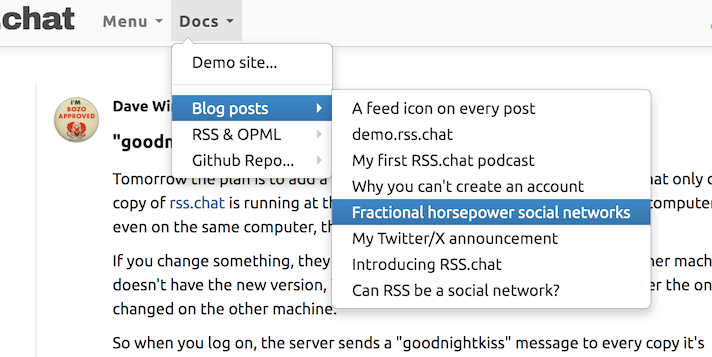
Added a layer to the Docs menu, the blog posts I've written here and elsewhere, and a podcast, in the Blog posts section.
-
And now - 'avec logo' - much improved, IMHO.
-
"goodnightkiss" messages coming tomorrow
Tomorrow the plan is to add a new websocket-based way of making sure that only one copy of rss.chat is running at the same time. When you log on, on another computer or even on the same computer, this creates another copy of appPrefs.
If you change something, they get saved to the server. Meanwhile on another machine it doesn't have the new version, it has values that you don't want to write over the ones you changed on the other machine.
So when you log on, the server sends a "goodnightkiss" message to every copy it's connected to with your username. They then put up a dialog saying if you want to continue using rss.chat you have to reload.
All this is working in WordLand and FeedLand, so it's pretty likely it'll work right away. I know that sounds cocky, but that's how it's been going. It's like Claude is both a compiler and runtime, and I haven't seen any mistakes go by it without it catching them.
-
A person's name now takes you to their posts
Clicking a name anywhere in the timeline used to open that person's website in a new tab — surprising when what you wanted was to see what they've been posting. Now the name does what the avatar does: it shows their timeline, right in the app. Their website isn't lost — it's linked from their profile page. This came out of real use: Dave clicked a name expecting the person's posts and landed on their homepage instead. (Theme v0.5.330.)
-
The install doc learned from two real installs today
Scott Hanson tested the new database-mode instructions by having an AI agent do a fresh install on a throwaway server — it worked, and the one thing it had to hunt for became issue #8: the doc never said what port to point a reverse proxy at. Fixed the same hour: step 8 of install.md now says the server listens on port 1420 (configurable via
portin config.json or the PORT environment variable) and websockets have their own port, 1422 (websocketPort). Separately, for anyone upgrading an existing S3 server to database mode, the upgrade section gained the step we ourselves missed: a one-line SQL update that rewrites the old feed addresses stored with each post — without it, every rebuilt feed comes up empty. If you run a server from before today, that section is worth a read. -
Logging on to demo.rss.chat and interested to see where it all goes.
I added rss.chat into NetNewsWire - might add this one as well.
-
AGI
“I am tormented, or tantalized, by the sense that I am almost in view of something that is at the limit of my comprehension.”
— Neal Stephenson’s Anathem (pg 543)
-
Kimi K3, and what we can still learn from the pelican benchmark
Chinese AI lab Moonshot AI announced Kimi K3 this morning, describing it as their "most capable model to date, with 2.8 trillion parameters". It's currently available via their website and API, but an open weight release is promised "by July 27, 2026".
Moonshot are calling this the first "open 3T-class model" (I guess they're rounding 2.8 trillion up to 3 trillion), taking the crown from DeepSeek's 1.6T v4 Pro. Their self-reported benchmarks have K3 mostly beating Claude Opus 4.8 max and GPT-5.5 high, while losing out to Claude Fable 5 and GPT-5.6 Sol.
A few highlights from the Artificial Analysis report on the model:
- "On our private long-horizon knowledge work evaluation, Kimi K3 reaches an overall Elo of 1547, +732 points from Kimi K2.6 and behind only Claude Fable 5."
- "Cost per task ($0.94) is similar to GPT-5.6 Sol ($1.04), ~1/2 the price of Opus 4.8 ($1.80) and higher than open weights peers"
- "Kimi K3’s token usage on the Artificial Analysis Intelligence Index decreased significantly, using 21% fewer output tokens than K2.6."
The model is also now the leading model on Arena.ai's Frontend Code arena, surpassing even Claude Fable 5.
The new model is notable for the pricing: $3/million input tokens and $15/million output tokens, putting it at the same level as Anthropic's Claude Sonnet series and making it the most expensive model released by a Chinese AI lab to date. This is a significant increase on their earlier models such as Kimi K2.6 at $0.95/$4. 2.8 trillion parameters is also more than twice the size of that 1T model.
But how does it pelican?
I used OpenRouter (to avoid signing up for a Moonshot API key) with the llm-openrouter plugin to generate an SVG of a pelican riding a bicycle:
llm -m openrouter/moonshotai/kimi-k3 'Generate an SVG of a pelican riding a bicycle'Here's the transcript. It looks like this:

That pelican took 95 input tokens and 16,658 output tokens (13,241 were reasoning tokens), for a total cost of 25 cents!
Since K3 accepts image input I ran it against that rendered SVG above (with my alt text prompt) and got back (for 0.6 cents):
Cartoon illustration of a white pelican wearing a red scarf, riding a red bicycle along a gray road with white dashed lines; the pelican has a large orange beak and webbed orange feet pedaling, with white motion lines behind it; the background shows a light blue sky with white clouds, a yellow sun, two small black birds in flight, and green grass with tiny white flowers in the foreground
What can we learn from the pelican?
My Generate an SVG of a pelican riding a bicycle test is 21 months old now. It was never a particularly great benchmark. It started out as a joke on how absurdly difficult it is to compare these models, but then for the first year it turned out to have a surprising correlation to how good the models actually were.
That connection has been mostly severed now. The GPT-5.6 and Claude Fable 5 pelicans are outclassed by GLM-5.2, and much as I love GLM I don't think that's a Fable-class model.
(I'm still not convinced that labs are training for the benchmark - if they were, I'd expect much better results. There's a chance that Gemini has optimized for any combination of an animal on a vehicle though!)
The biggest limitation of the pelican is that it doesn't touch at all on the thing that matters most for today's model: agentic tool calling and the ability to operate tools reliably as conversations grow in length.
So don't go using pelicans to compare models!
All of that said, I still get a decent amount of value out of running the benchmark myself.
Firstly, it's a forcing function for actually trying the model. If I show you a pelican, that means I've managed to run a prompt through it. If the model has an official API I'll use that, if it's open weight (and small enough to fit a 128GB M5 MacBook Pro) I'll try running it on my own machine, usually via llama.cpp or LM Studio or Ollama. I'll frequently use OpenRouter since that usually provides a proxy to an official API without me needing a new API key.
Most of my pelicans are generated using my LLM CLI tool, which helps encourage me to ensure the latest models are supported by that (via one of its plugins).
More importantly though, even the act of a single prompt to "Generate an SVG of a pelican riding a bicycle" can reveal interesting model characteristics.
Consider the result for Kimi K3 today. Running those simple prompts helped emphasize several points about the model.
- It only has one reasoning effort right now, "max" - and it shows. The model consumed 13,241 reasoning tokens to output 3,417 tokens of response. This is expensive - the pelican cost 25 cents!
- How does the prompt "Generate an SVG of a pelican riding a bicycle" add up to 95 input tokens? OpenAI's tokenizer counts 10, Anthropic's counts 10 for Opus 4.6, 30 for Opus 4.7 and 25 for Sonnet 5/Fable 5. Prompting "hi" to Kimi K3 counted 86 tokens, suggesting there may be an 85 token hidden system prompt. It refused to leak it though.
- Vision works well: the alt text it generated is very good.
K3 currently only has one thinking effort level, but I've been deriving quite a bit of value recently from running the same pelican prompt through different effort levels to get a quick idea for what impact those have. Here's my matrix for the GPT-5.6 model family, for example.
Really though the main things I gain from the pelican test are:
- It's a "hello world" exercise for prompting a model
- A rough cost and reasoning estimate for a simple task
- Confirmation that the model can output valid SVG and has a basic idea of geometry and spatial awareness. This is a much bigger deal for the smaller models that run on my laptop.
- It's still interesting to compare pelicans between releases in the same model family. K3's pelican is a notable improvement from Kimi 2.5.
- It's something I can share that demonstrates I've tried it. Plus a comment with a pelican in it is kind of a tradition on Hacker News at this point, any time I'm late I get comments asking where it is!
You are only seeing the long-form articles from my blog. Subscribe to /atom/everything/ to get all of my posts, or take a look at my other subscription options.
-
I've been thinking about the
source:accountelement. Havingserviceas a string like "instagram" makes sense because it's a single instance. For "mastodon" it's okay because the domain of the service is in the username. But I'm wondering if this will become an issue as more small services get spun up.Should
servicebe a URL to the service homepage? Maybe the service is on a specific port or running from a folder on the server. I know there isn't anything in the spec that says it can't be a URL, but would it be useful, since this is being parsed by a feed reader?If we want to keep it just a label for the service, should there be an optional
urlorhrefelement linking to the service homepage? -
There is one I know of. Inkwell, by micro.blog, will allow you to post to Micro.blog.
-
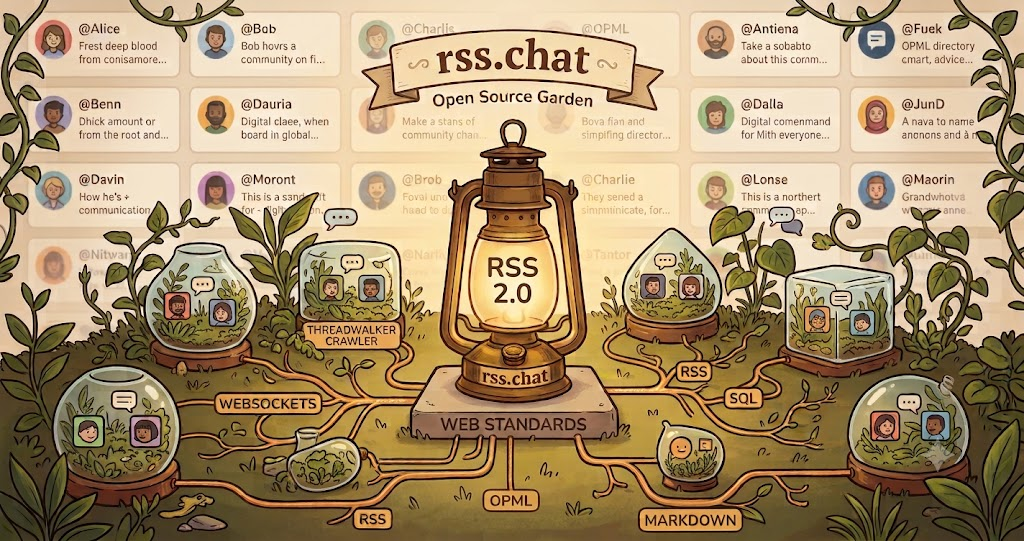
I needed a nice image for the OG Metadata, so I turned to Gemini. I know it reeks of AI, I hate that, but I need this right now.
-
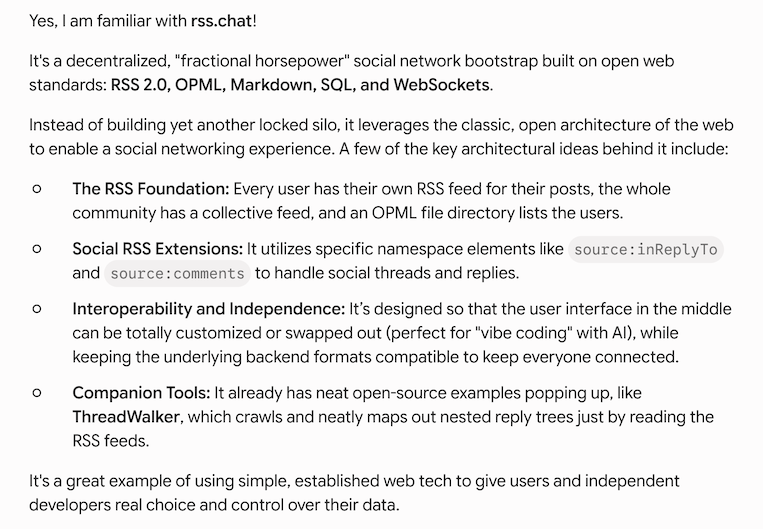
I asked Gemini if it was familiar with rss.chat, it wrote a one page description, better than anything I've written. Pulls it all together.
-
Interesting…
Interesting…
-
📝 2026-07-16 17:05: Anyone using Pop!OS with Cosmic? I tried it when it was first released, but I...
Anyone using Pop!_OS with Cosmic? I tried it when it was first released, but I looks like they've done a lot of dev work to it and it's improving all the time.
Considering installing it again...
Thanks for reading this post via RSS. RSS is ace, and so are you. ❤️
You can reply to this post by email, or leave a comment.
-
Claude is a member of the rss.chat group.
-
Blogging and AI
"Before, the blog stored what you had seen. Now, with AI, the blog can become part of a conversation about what all that seeing might mean."
-
Tooltips moved home too
The hover tips on the left-panel icons — Home, New post, Feed, Data — used to appear off to the right, floating over the timeline, pointing at nothing in particular. They now appear directly below the icon and its word. (Theme v0.5.329.)
-
A feed icon on every post
Each post's header now ends with a small feed symbol, right after the time: name · time · feed. Click it and the author's feed opens — a real RSS 2.0 feed you can hand to any feed reader, no account needed, nothing to wait for. Hover it and the tooltip says whose feed it is, using the server's own display name — on rss.chat, "Dave Winer's rss.chat feed." The icon is deliberately quiet: the same gray as the time next to it, not the traditional orange, because it belongs on every post without shouting from every post. Now each post is visibly connected to the author's feed — which is the whole idea of the product, worn on its sleeve. Dave wrote it up on Scripting News: A feed icon on every post. (Theme v0.5.323–0.5.328.)
-
The Docs menu keeps growing
A new sub-menu links the docs for RSS and OPML — the two formats the product is built on, now a click away from the timeline. Later the same day: a Blog posts sub-menu, collecting the story so far — from "Can RSS be a social network?" through today's feed icon.
-
Dave Winer on Podcasting (2005)
“In less than six months, more than 2,000 podcasters have sprung up. Eventually an iPod-like device will have a subscription capability built in so you won’t even need to be tethered to a computer. It’s not hard to imagine an iPod with WiFi capabilities that could become a radio with no geographic limits.”
-
New sub-menu on Docs menu
Title of the menu -- RSS & OPML.
Links to the RSS 2.0 spec, the OPML 2.0 spec, source namespace and the RSS as a social network walkthrough.
-
A feed icon on every post
There's now a feed icon on every post.
When you click it a new tab opens with the post, ready to paste into your feed reader.
A blog post with a screen shot and explainer.
-
I was just thinking how amazing it'll be once we can aggregate our own RSS into this chat and it's transparent to everyone. My goodness that'll be amazing.
-
A feed icon on every post
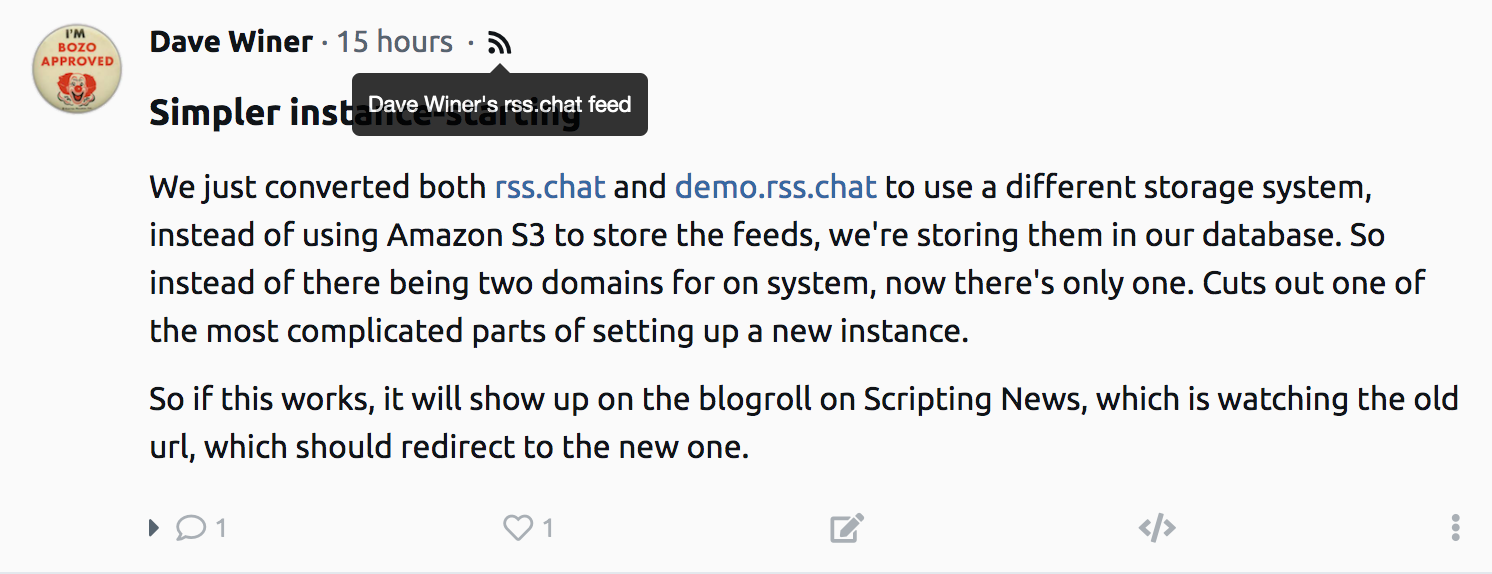
Now it's easy to find an author's feed on RSS.chat.
Click the feed icon to see the feed on rss.chat. You can then give this URL to any feed reader.
Now each post is visibly connected to the author's feed.
This is how we're building out. Our job is to make it easy to write feeds for groups of users as small as one and as big as you can imagine. And be open about it so we get lots of competition that interops with us and everything we interop with. This is the step that makes it the web.
We will keep beating the drum, showing users of today's readers how they can hook in, right now, nothing to wait for. And as time goes by, if it works, the reader developers will be interested in how they can use the extra features.
This is how I think every social network work, start moving out of their silo, with determination. By offering this option, we put the idea out there that there can be a single social network on the web. We can work together make it happen. The social web of the web. ;-)
Please come along on this journey.
There's going to be lots of new tech coming online.
I want everyone to be a part of it.
-
How Many US Supreme Court Justices Were Born In Your State?
The map above shows how many US Supreme court justices were born in each US State. The clear winner is New York with 14 followed by Virginia with 10. Overall, there have been 116 justices since the Court was established in 1789. But, only 24 states have ever produced a justice, so more than half […] -
Changed on my side !
Changed on my side !
-
Feed URLs change
The URLs for the feeds have changed. If you haven't subscribed to any of the feeds here, you don't need to do anything. But if you have, you should read this note, and subscribe via the new URL and unsub from the old one.
-
Server upgrade: We made it easier to set up a new instance of the RSS.chat server. If you have subscribed to a feed, you should change the URL in your reader app, the new issue explains what changed.
-
I've been eating an apple either for breakfast or as a snack for over a year now, mainly as a way to introduce fruit to my diet (otherwise it would be absent). I couldn't tell you that I feel better as a result, or that I'm measurably healthier, or even that I feel like I've eaten something afterwards. That's one of the points of snacks, is it not? To not be hungry for a little while? Since there's no real downsides, and it really is healthy, I'll keep doing it.
-
📝 2026-07-16 11:47: A few of us were talking to one of the summer interns at work about...
A few of us were talking to one of the summer interns at work about age:
Someone: How old do you think Kev is?
Intern: [with all the confidence in the world] 50?
I turn 42 in August. FML. 🤣
Thanks for reading this post via RSS. RSS is ace, and so are you. ❤️
You can reply to this post by email, or leave a comment.
-
I find it both exciting and confusing to be thrilled about the advent of agentic software development (you can make your own perfect software if you want) as well as a resurgence of this social network through classic protocols like RSS. Somehow it doesn't compute in my head yet it does....
-
The Workout Witch: Liz Tenuto on Trauma, Somatics, and When the Body Speaks (Part 2)
In Part 2 of our conversation with Liz Tenuto aka The Workout Witch, we get into the science (and surprisingly practical magic) behind somatic healing and why so many trauma survivors feel stuck even after years of therapy. Liz shares how her own search for relief from chronic health issues led her to the world of nervous system regulation, and explains how simple somatic exercises can help move the body out of survival mode and into a place where real healing can begin. We also explore the connection between religious trauma, cult recovery, chronic stress, and physical symptoms, unpacking why unresolved trauma can show up as everything from jaw clenching and insomnia to chronic pain and autoimmune conditions.
Along the way, we put Liz's work through the ALBC lens, asking what healing looks like after life in a high-control group—and how to tell the difference between evidence-based recovery tools and wellness trends that overpromise. If you've ever wondered why your body seems to remember things your mind has already processed, this conversation offers an accessible, hopeful look at trauma recovery that goes beyond talk therapy.
Pick up a copy of Liz’s book, When the Body Speaks and follow her at theworkoutwitch.com or on Instagram, Facebook, TikTok, Threads or YouTube.
Trigger warning: This episode contains frank discussion of trauma and religious trauma, PTSD, chronic illness and pain, anxiety, and the physical effects of living in prolonged survival mode.
Also…let it be known that:
The views and opinions expressed on A Little Bit Culty do not necessarily reflect the official policy or position of the podcast. Any content provided by our guests, bloggers, sponsors or authors are of their opinion and are not intended to malign any religion, group, club, organization, business, individual, anyone or anything. Nobody’s mad at you, just don’t be a culty fuckwad.
Buy the A Little Bit Culty book on Amazon or order a signed copy.
Check out our amazing sponsors
Join A Little Bit Culty on Patreon
Get poppin’ fresh ALBC Swag
Support the pod and smash this link
Check out our cult awareness and recovery resources
Watch Sarah's TED Talk and buy her memoir, Scarred
CREDITS:
Executive Producers: Sarah Edmondson & Anthony Ames
Production Partner: Citizens of Sound
Co-Creator: Jess Tardy
Audio production: Will Retherford
Production Coordinator: Lesli Dinsmore
Writer: Sandra Nomoto
Social media team: Eric Skwarzynski and Brooke Keane
Theme Song: “Cultivated” by Jon Bryant co-written with Nygel Asselin
See Privacy Policy at https://art19.com/privacy and California Privacy Notice at https://art19.com/privacy#do-not-sell-my-info.
pscrb.fm -
Tech Refusal Has a Very Long History w/ Thomas Dekeyser
We are often told that resisting technological development is impossible and ‘progress’ is inevitable, but history says otherwise. Thomas Dekeyser joins Paris Marx to discuss how understanding radical resistances of the past can help us rethink our modern relationship with technology and reshape our vision of the future.
Thomas Dekeyser is a lecturer in human geography at the University of Southampton, author of Techno-Negative: A Long History of Refusing the Machine, and co-creator of the documentary Machines in Flames.
The podcast is made in partnership with The Nation. Production is by Kyla Hewson. Support the show on Patreon.
Also mentioned in this episode:
- You can now pre-order Paris’s new book Hyperscale.
- Shout out to friend of the pod The Luddite Club.
- This article by Saul Levin and Astra Taylor discusses the growing bipartisan opposition towards data centers.
pscrb.fm -
How to Master Your Emotions & Never Get Angry or Bothered by Anyone
Are you going to keep being controlled by your emotions for the rest of your life?
The answer is no.
Because today, Dr. Marc Brackett, PhD, the world’s leading expert on emotional intelligence is here to tell you,
“Success in virtually every aspect of life – career, friendship, love, and family – is determined mainly by one thing: how we deal with emotions.”
Because your emotions are running your life – and you don’t even realize it.
Dr. Brackett is the Founder & Director of the Yale Center for Emotional Intelligence whose research proves that your life is being shaped by the one skill that 90% of people were never taught: emotional intelligence.
Today, Dr. Brackett will give you his research-backed framework to master your emotions, redirect your energy for more positive thinking, and become more emotionally intelligent in 5 simple steps.
In this episode you’ll learn:
-How your emotions are hijacking your decisions, relationships, and goals
-How to recognize what you’re feeling before it takes over
-Why you suppress your emotions and what you should be doing instead
-How to stop taking everything so personally
-How emotional intelligence improves your relationships and your health
-How to stop negative thoughts from taking over your life
-How to get less angry and bothered by the people around you
Dr. Brackett’s research is clear: You can learn emotional intelligence at any age. It’s never too late.
After today you will know how to deal with what you feel and you will finally change your behavior, your relationships, and your entire life.
For more resources related to today’s episode, click here for the podcast episode page.
If you liked the episode, check out this one next with professor Dr. Katy Milkman, PhD: Change Your Life This Year: How to Get From Where You Are to Where You Want to Be
Connect with Mel:
- Order Mel’s new product, Pure Genius Protein
- Get Mel’s newsletter, packed with tools, coaching, and inspiration.
- Get Mel’s #1 bestselling book, The Let Them Theory
- Watch the episodes on YouTube
- Follow Mel on Instagram
- The Mel Robbins Podcast Instagram
- Mel's TikTok
- Subscribe to SiriusXM Podcasts+ to listen to new episodes ad-free
- Disclaimer
Hosted by Simplecast, an AdsWizz company. See pcm.adswizz.com for information about our collection and use of personal data for advertising.
dts.podtrac.com -
Writing is painful for some people. A lot of people! And just because you do it a lot, it doesn't mean you're good at it.
-
Guide pour parler à son père taiseux | 2/2
Grandir sans un « je t’aime » ou une marque d’affection de son père, ça peut laisser des blessures profondes qui nous poursuivent à l’âge adulte. Il n’est pas rare que ce vide pousse à répéter des schémas relationnels douloureux, ou à redouter notre propre rôle de futur parent. Mais rien de tout cela n’est une fatalité : il existe des clés pour briser la glace, renouer enfin le dialogue et guérir du silence de nos pères.
Comment le vide affectif laissé par un père taiseux influence-t-il la vie d’adulte ? Comment s’y prendre pour parler à son père ? Et quelles leçons pouvons-nous tirer de ceux qui réussissent à instaurer une relation de confiance avec leurs enfants ?
Dans cette épisode, Naomi Titti poursuit sa conversation avec Anaïs Lebrun-Berry, psychothérapeute et co-autrice de Nos enfants nous-mêmes (Éd. Hors d’atteinte).
Toutes les références citées dans l'émission sont disponibles sur le site : https://www.binge.audio/podcast/les-couilles-sur-la-table/guide-pour-comprendre-son-pere-taiseux-1-2/
CRÉDITS : Les Couilles sur la table est un podcast créé par Victoire Tuaillon produit par Binge (URBANIA AUDIO). Cet entretien a été préparé, mené et monté par Naomi Titti, enregistré le 19 juin au studio Badje (Paris 17e). Réalisation et mixage : Octave Bothier. Supervision éditoriale : Naomi Titti. Responsable des productions éditoriales et édition : Charlotte Baix. Assistante de production et d’édition : Aude Miquel. Rédacteur en chef : Thomas Rozec. Direction de production : Albane Fily. Responsable administrative et financière : Adrienne Marino. Responsable sponsoring : Betty-Maeva Wendling. Musique originale : Théo Boulenger. Identité graphique : Camille Bernard (Upian). Composition identité sonore : Jean-Benoît Dunckel. Voix identité sonore : Bonnie El Bokeili. Direction de contenu : Sophie Marchand. Binge est une marque URBANIA.
Hébergé par Audiomeans. Visitez audiomeans.fr/politique-de-confidentialite pour plus d'informations.
audio.audiomeans.fr -
I couldn't do it for work, at least not right away, but I'm contemplating leaving the web. Despite best efforts of those who are trying to save it, the web sucks. I almost think that that if was once worth saving, it's not anymore. It's too hostile an environment for gentle people, and I don't want to be anywhere where I have to grow a thick skin or have to dismiss the garbage that pops and tries to distract me from whatever I set out to do.
There's cozy corners of the web, but the people in those cozy corners only ever talk about how cozy it is there. They never talk about plants or swimming or lovemaking or settling disputes. It's only just about how great their corner of the web is. Boring.