@ricardo — following
Follow buttons here act as you, not as @ricardo.
@ricardo follows
| Label | Kind | State | Action |
|---|---|---|---|
| @admin | local | — | |
| scripting.com | source | — | — |
| rmendes.net | source | — | — |
Timeline
-
La pauvreté de la pensée dans les médias français et belges est quasi un cas d’é...
Reply sourceLa pauvreté de la pensée dans les médias français et belges est quasi un cas d’école : on assiste à un système qui, au lieu de regarder la poutre dans ses propres yeux, se vautre dans la violence et les accusations contre l’Autre, ici LFI ou les blocs radicaux, pour construire le mythe de la rationalisation de la violence qu’il produit envers les personnes qu’il prétend représenter.
Et ça va s’empirer, l’état français a depuis longtemps perdu tout contact avec la réalité, le tout alimenté par des forces du désordres endoctrinées, infiltrées par des éléments radicaux extrêmes qui trouve dans “les forces de l’ordre” un milieu pour exercer, contre une partie de la population, le monopole de la violence de l’état, contre sa population.
C’est à gerber en fait.
-
Israel cannot edit its crimes out of history
Reply sourceAccording to “Middle East Eye” (https://www.middleeasteye.net/news/israeli-embassies-uk-us-promote-copycat-naza-weeks-after-originals-venice-triumph), Israeli embassies in Britain and the United States are promoting a rival to NAZA to challenge allegations of genocide in Gaza. It even borrows the name: “NAZA: The Real Story” (https://nazadocumentary.com/).
The arrogance is staggering. A state confronted with evidence of its own crimes mobilises its diplomatic machinery to sell the world a more flattering version. As though Palestinian lives could be buried a second time, beneath a better communications campaign.
The original “NAZA, by Yuval Abraham and Rachel Szor” (https://www.theguardian.com/film/naza), brings forward testimony from Israeli military insiders. But the evidence extends far beyond one film. “Amnesty International’s investigation” (https://www.amnesty.org/en/documents/mde15/8668/2024/en/) documented civilian killings, destruction, forced displacement and the denial of essential supplies, concluding that Israel had committed genocide against Palestinians in Gaza.
What disgusts me is the assumption behind this exercise: that enough messaging can make the world look away. That the destruction of Palestinian life can somehow become a matter of choosing which trailer you prefer.
A counter-documentary must answer the evidence. Borrowing a title and obtaining embassy endorsements proves nothing. Neither does putting military officials in front of a camera to explain themselves absolve them of responsibility.
And alongside this campaign comes the branding of the filmmakers as traitors. “El País reports” (https://english.elpais.com/culture/2026-09-27/the-suffocation-of-israeli-filmmakers-critical-culture-is-now-regarded-as-an-act-of-treason.html) that Culture Minister Miki Zohar called Abraham and Szor traitors and demanded that their citizenship be revoked. Filmmaker Uri Rosenwaks described the threats against them: “People are calling for them to be hanged, for them to be killed.”
Calling for filmmakers to hang because they expose your country’s violence is barbaric. A minister branding them traitors helps create a climate in which persecution can pass for patriotism. The message reaches every journalist, artist and witness: speak, and you too could become a target.
The historical parallel with Nazi Germany lies in this treatment of dissent as betrayal. The “United States Holocaust Memorial Museum documents” (https://encyclopedia.ushmm.org/content/en/article/the-press-in-the-third-reich) how the Nazi regime crushed independent newspapers, drove journalists into exile and used imprisonment and concentration camps against those deemed to be harming Germany. That history shows where the demand for absolute national loyalty can lead when exposing wrongdoing becomes an offence against the nation.
More than 200 Israeli filmmakers have expressed solidarity with Abraham and Szor. Their resistance matters. So does recognising the authoritarian logic of those threatening them: protect the state’s reputation, punish the people who expose its violence, and teach everyone else to stay silent.
Israel’s reckless violence and its government’s arrogant denialism belong in the same historical record. Every effort to sanitise that record deserves scrutiny, especially when it carries the authority of a state.
No film will bring back the dead. No publicity campaign will undo the destruction. No counter-documentary will erase the crimes or cancel the demand for accountability.
Watch the “original NAZA trailer” (https://www.theguardian.com/film/video/2026/sep/25/naza-official-trailer). Read the evidence. Refuse the invitation to forget.
-
RSS tip #2
Reply sourcePeople really liked the RSS tip I posted the other day, so here's another one, also related to the channel-level title element.
Consider the screen shot below, and the Thinking about... blog.

Part of a blogroll with limited info about a great blogger, Timothy Snyder.
I can't tell from the title who's speaking, whereas with the two feeds above it I know it's Brian Lehrer and Kottke, and below, an excellent local site called The Overlook.
Now it's a shame that it doesn't say who's doing the thinking because it's someone who is on a roll right now, historian Timothy Snyder. So the title pretty much has to say his name, if it's going to look good in a list of other bloggers.
BTW, just listened to Snyder on the Scott Galloway podcast, another thinker who I've just started listening to. With the two of them together, you will learn a lot.
So remember the title sometimes is the only handle a reader has to figure out what it is. Choose it carefully and make sure it looks good in a tight space like the one shown below.
If you have questions about how to make your RSS 2.0 feeds work better, please add note below. If I don't know maybe someone else does.
-
Pas du tout surpris de voir la ministre de l’éducation belge utiliser exactement...
Reply sourcePas du tout surpris de voir la ministre de l’éducation belge utiliser exactement les mêmes propos que ce qui se fait chez nos amis français, la caste politique belge a l’art de bêtement suivre la France comme des moutons comme si les lycéen-es n’avaient pas de motivations autres que celles d’être “manipulé” par de soit disant mouvement radicaux dont il faut encore déterminer la provenance réelle : c’est pas la première fois que le monopole de la violence (l’état) orchestre des éléments radicaux qu’il utilise ensuite pour discréditer un mouvement citoyens 100% légitime, ça fait malheureusement partie des tactiques de bases qu’on retrouve à l’œuvre dans toutes bonne démocratie malade qui se respecte.
Le mythe du “black bloc” sert davantage l’état et son monopole de la violence qui lui donne la rethorique dont il a besoin pour activer la répression et la violence contre des adolescents, des enfants en jouant de la polarisation de la société pour noyer le poisson et faire accepter l’énorme violence déclenchée qui en découle.
C’est à chaque fois le même scénario : les véritables revendications sont noyées au profit d’un “débat” souvent noir ou blanc sur la violence, toujours la même, celle des “casseurs”, jamais celle de l’état, qui lui organise la violence et la précarité de toute une génération qui est censée baisser la tête et obéir plutôt que de se lever pour exiger des conditions dignes.
Et ça fait des décennies que ça dure, les émeutes des banlieues de 2005 sont déjà loin, plusieurs ministres de l’intérieur ont participé à la création du mythe d’un état dit démocratique qui face à la gronde populaire se voit dans l’obligation de casser tous mouvements citoyens d’envergure qui remettrait le status quo en question.
L’important n’est plus le progrès pour nos démocraties malades, c’est la permanence Éternelle de la dégénérescence démocratique organisée par ceux-là même qui prétendent nous représenter.
- Reply source
2001: "Like a boat, a human being has integrity if he or she is what he or she appears to be. That's why integrity commands us to disclose conflicts, so that what we say, and who we appear to be, are in synch. Change the appearance if necessary."
- Reply source
- Reply source
I like the way AI is evolving, with Muse from Meta and Dots from OpenAI. Even the main programs, ChatGPT for example, are starting to provide real world services that the providers, ie banks, groceries, airlines, health care portals etc should be providing. They could possibly take over commerce the way Amazon has taken over shopping. There's room to improve in everything about the way we do business. And it seems like they've been researching this and experimenting (of course) and this is what they've come up with. Haven't tried them yet, but it's a good direction to go. It really should be Apple and Google doing this, btw. Also ChatGPT can help you understand your credit score. That's something I'd seriously like to ask some questions about.
-
BloggerCon and RSS 2.0
Reply source After running the first Bloggercon at Harvard in 2003 a famous tech company had a meetup to talk about the same stuff in a private invite-only session in the Bay Area. The invitations went to all the discussion leaders at Bloggercon. People I chose. I was not invited. Only one of my friends told me about it. Not sure if any of them went.
Second time, Google invited a bunch of people I was working on with RSS 2.0 to a private meeting. Most of the people I was working with, but again, not me. Had I been there, I would have said don't reinvent, let's work together, do all the things you want, but slowly, with real software and real users, but that wasn't the plan.
In the first case I think the publisher was trying to decide if they should compete with BloggerCon, and Google wanted to build a protocol that was more ambitious than RSS 2.0. They likely were sincere in that, but they had not learned that bootstrapping worked way better than Immaculate Conception, where a small group of insiders invent something complicated out of thin air that rocks the world. If you look at history, there aren't many examples of that. Eventually, as I understand it, that became ActivityPub. I think things would have turned out much better if Google had kicked back and let the process that got us to RSS 2.0 continue. But everyone wants to work with the BigCo, I've learned repeatedly that it's much more likely to work if you join forces with individual developers, not big companies.
I only held four BloggerCon's, I would have been happy to work with a publishing company and turn it over to them, with some rules about what they could and couldn't do with it, for example it was a user's conference, the tech industry was welcome, but it wasn't for them. When we did BloggerCon at Stanford in 2004 that was apparently very hard for the tech people to get. Many of them tried to pitch their products and were prevented from doing so.
-
Les problèmes systémiques de nos gouvernements sont des bombes à retardement qui...
Reply sourceLes problèmes systémiques de nos gouvernements sont des bombes à retardement qui ont été plantées par nos gouvernements.
Il n’y a pas à faire des efforts ou se serrer la ceinture, tout à été prémédité, c’est une forme de terrorisme politique appliqué à grande échelle déguisé en crises à répétitions qui ne sont que le fruit de leurs propres décision politiques.
La dette Le climat La misère Les paradis fiscaux
Tout à été décidé.
l’inertie politique est la quintessence de l’exercice d’un mandat politique : s’engraisser et ne rien faire tout en prétendant savoir quoi faire pour se faire élire.
-
Vous saviez.
Reply sourceNous savons prévoir. Vous avez décidé de ne pas gouverner.
Les enfants qui entreront à l’école en septembre 2031 sont nés. Vous les avez comptés. 643 905. Vous savez où ils vivent. Vous avez publié des projections jusqu’en 2070.
Et en septembre 2031, vous direz que vous ne pouviez pas prévoir.
Ce texte est écrit pour que cette phrase ne soit plus disponible.
À qui je parle
Pas à un homme. Un homme, ça se remplace, et vous comptez là-dessus.
Je parle à ceux qui signent. Au Premier ministre qui a signé le décret de 2006 transformant le Commissariat général du Plan en centre d’analyse, à celui qui a signé celui de 2013, à celui qui a signé la fusion de 2025. À la direction du Budget, à Bercy, dont le métier est d’arbitrer sans avoir à motiver, et qui a cherché 12 % d’économies sur le 1 % de Matignon consacré à penser le pays dans vingt ans. Aux ministres de la Justice, de la Santé, de l’Intérieur, de l’Éducation qui ont reçu les rapports, lu les chiffres et défendu en séance le budget qui les ignorait. Aux majorités, de droite comme de gauche, qui ont voté ces budgets chaque automne depuis trente ans. Aux conférences des présidents qui ont tenté, trois fois, de bloquer une loi sans étude d’impact, et aux neuf du Conseil constitutionnel qui, trois fois, vous ont donné raison.
Vous, c’est une chaîne de signatures. Elle a des noms, des dates et des numéros de décret. Vous êtes identifiables un par un, et vous avez organisé le système pour qu’on ne vous nomme jamais ensemble.
Je le fais ici.
Vous ne manquez de rien
Arrêtez de dire que vous ne saviez pas.
Vous saviez pour les tribunaux. Vos propres états généraux l’ont chiffré en 2022 : 1 500 magistrats, 3 000 greffiers, 2 000 agents. Vous saviez pour les urgences : votre Cour des comptes l’a écrit en 2024. Vous saviez pour les forêts : vos pompiers vous le disent chaque printemps. Vous saviez pour les professeurs : vous avez relevé le niveau de diplôme en 2022 sans même calculer ce que ça ferait au vivier, et vous avez fait marche arrière quand les classes sont restées sans enseignants.
Six mille affaires criminelles en attente. Six ans pour juger un viol. Ces chiffres ne sont pas les nôtres. Ce sont les vôtres, présentés par votre ministre, au conseil des ministres, en mars.
Vous n’avez pas un problème de connaissance. Vous n’avez jamais eu un problème de connaissance. Vous avez plus de données, plus de calcul et plus d’études que n’importe quel État avant vous, et vous commandez encore une étude, ce qui est une manière respectable de ne rien faire pendant dix-huit mois.
Rien ne vous manque. Sauf une obligation d’en tenir compte.
Vous avez fait le tri des paroles
Trois mille magistrats ont signé une tribune. Cinq mille cinq cents en une semaine. Six sur dix. Ils ont écrit qu’on leur laissait le choix entre juger vite et mal, ou juger bien dans des délais inacceptables. Un vice-procureur a écrit qu’il devait « survoler certains dossiers ». Un autre a parlé de « l’abattage ». C’est leur mot.
Vous avez appelé ça une doléance. Vous avez reçu une délégation.
Mettez la même information dans un tableau, une ligne, une colonne, « capacité soutenable : cent quatre-vingts dossiers », et elle devient de l’expertise. L’expertise, elle, entre dans vos arbitrages.
C’est la même information. Ce n’est pas le même pouvoir. Et c’est vous qui avez décidé, en amont de tout, quelle parole avait le droit de vous contraindre : celle du cabinet de conseil, oui. Celle du greffier qui ne tient plus, non.
Vous avez coupé ce qui ne proteste pas
Vous avez un mot pour la marge : une dépense.
Un camion qui ne roule pas coûte de l’argent. Un pompier qui attend coûte de l’argent. Un lit vide coûte de l’argent. Un magistrat de plus coûte de l’argent. Une école construite avant la saturation coûte de l’argent.
Alors vous avez coupé. Et regardez ce que vous avez coupé en premier.
À l’hôpital, en dix ans, les effectifs ont augmenté. La part des administratifs est restée la même. Celle des infirmiers aussi. Ce que vous avez supprimé, ce ne sont pas des gens. Ce sont des lits. Parce qu’un lit vide ne fait pas grève. Une réserve d’eau ne se syndique pas. Un camion qui ne roule pas n’écrit à personne.
Vous n’avez pas confondu efficacité et absence de marge. Personne n’a rien confondu. Quelqu’un a fermé des lits, quelqu’un d’autre a inscrit la fermeture en gain, et un troisième a signé. Ce sont des noms, des dates et des montants. Ce ne sont pas des circonstances.
Vous comptez très bien
Je ne vous accuse pas d’imprévoyance. Ce serait vous faire un compliment.
Il n’y aura jamais de journal télévisé pour les trois cents maisons qui n’ont pas brûlé. Pas de reportage sur l’enfant qui n’a pas été agressé parce que son dossier a été traité à temps. Pas de ruban à couper devant l’hôpital qui n’a pas été débordé. La prévention est invisible, et vous le savez mieux que quiconque.
Alors vous arbitrez contre elle. Et vous avez raison, dans votre calcul : ce que vous abandonnez ne se verra pas, ce que vous financez à la place se verra. Vous ne vous trompez pas. Vous comptez correctement.
C’est précisément pour ça qu’on ne vous demandera plus de bonne volonté.
Vous avez fait de la catastrophe un rite
L’été arrive. La forêt brûle. Vous découvrez le feu.
La rentrée arrive. Il manque des professeurs. Vous découvrez les enfants.
Les tribunaux débordent. Vous découvrez les dossiers. Les urgences saturent. Vous découvrez les malades.
Puis la crise quitte les journaux, et vous recommencez l’année suivante.
Ce n’est pas de l’oubli. Ce n’est pas de l’amnésie. Un cycle qui se reproduit à l’identique pendant trente ans n’est pas un dysfonctionnement. C’est un fonctionnement, et il fonctionne pour vous.
La catastrophe vous rend un service précis : elle transforme un arbitrage ancien en événement neuf. Un arbitrage a un auteur. Un événement tombe. Alors vous vous indignez, vous convoquez, vous ouvrez une enquête, et l’enquête vise toujours celui qui tenait le volant. Jamais celui qui avait vidé le réservoir quinze ans plus tôt.
Au printemps, après la mort d’une enfant, le président de la République a dit qu’il ne voulait « entendre aucun argument de moyens ». Bien sûr. L’argument de moyens, c’est le seul qui remonte jusqu’à lui.
Un pouvoir qui organise chaque année sa propre mise en accusation, à condition qu’elle porte sur ses agents et jamais sur ses arbitrages, n’a rien à craindre de nos colères. Vous les avez prévues aussi.
Le mot « manque » est un mensonge
Une justice qui met six ans à juger un viol n’est pas en panne. Elle trie. Le tri est ce qu’elle produit, et le tri a des bénéficiaires.
Une école à qui il manque des professeurs, toujours dans les mêmes quartiers, ne rate pas sa mission. Elle en remplit une autre, que personne n’a écrite.
Un hôpital sans lits n’échoue pas à soigner. Il décide qui attend et qui passe.
Vous appelez ça un manque. Le mot sert à ne nommer ni les gagnants ni les perdants. Mais il y en a. Ceux qui attendent six ans d’être jugés paient pour d’autres lignes budgétaires, choisies par des gens identifiables, à des dates connues.
Ce n’est pas une défaillance. C’est une décision de répartition. Dites-le, ou nous le dirons à votre place.
Vous avez déjà rendu vos réponses inutiles
On vous a demandé de répondre. Trois fois.
Le Pays de Galles vous a montré la voie en 2015 : un organisme public qui n’écoute pas doit s’en expliquer. Dix ans après, l’auditeur gallois conclut à un manque de mordant, et la loi ne touche toujours ni aux effectifs ni au budget.
Le Conseil d’État vous a demandé, avec Grande-Synthe, de justifier votre trajectoire climatique. Vous avez répondu. Il a trouvé ça suffisant. Il a refermé le dossier en 2025. Vos émissions baissent cinq fois moins vite que votre propre trajectoire. Frais de procédure : 6 000 euros.
Et vous avez écrit dans la Constitution, en 2008, la sanction maximale : pas d’étude d’impact sérieuse, pas de loi. Elle a servi trois fois. Trois fois, vous avez saisi le Conseil constitutionnel le jour même. Trois fois, il vous a donné raison. Il compte neuf membres. Vous en nommez trois. Vos deux présidents de chambre nomment les six autres.
L’arbitre est désigné par ceux qu’il arbitre. Vous ne l’avez pas subi. Vous l’avez construit ainsi.
Ce qui a manqué n’est ni le juge, ni l’obligation, ni la sanction. C’est que personne n’a jamais eu à juger si votre réponse en était une. Tant que produire le document suffit, vous cochez la case.
Vous savez écrire un chiffre
Ne dites pas que c’est impossible. Vous l’avez fait.
Une banque a un ratio de fonds propres. Il est écrit. Il est le même pour tout le monde. Quand elle passe dessous, les conséquences tombent sans que personne ait à les vouloir : dividendes plafonnés, rachats d’actions plafonnés, bonus plafonnés, soixante pour cent, quarante, vingt, zéro. Personne ne demande à la banque si elle s’est bien expliquée. Le chiffre est franchi ou il ne l’est pas.
Vous avez su écrire ça. Pour des bilans.
Vous n’avez pas su l’écrire pour un tribunal, une caserne ou un service d’urgences. Ce n’est pas une différence de technique. C’est une différence de qui vous vouliez protéger.
Alors écrivez-le.
Aucun magistrat ne peut se voir affecter plus de tant de dossiers. Aucun territoire ne descend sous tant de lits pour tant d’habitants. Aucun massif classé à risque n’entre en période rouge sans tant de moyens positionnés. Une phrase. Pas de rapport. Pas de cabinet. Un greffier n’a pas besoin de modéliser 2050 pour compter quatre cents dossiers sur son bureau.
Vous direz que c’est rigide. Que ça ligote le gestionnaire. C’est vrai. C’est exactement ce que dit une banque de son ratio, et vous ne l’avez jamais écoutée.
Ce qu’on vous retire
Nous ne vous demandons pas de prédire l’avenir. Nous vous demandons d’accepter que vous ne le connaissez pas, et de signer.
Aujourd’hui, la phrase disponible après la catastrophe est : « nous n’avions malheureusement pas les moyens ». Elle n’a ni auteur, ni date, ni montant.
Demain : « nous savions que cette décision créerait cette vulnérabilité, et nous avons mis l’argent ailleurs ». Signée. Datée. Chiffrée.
Vous garderez le droit de ne pas suivre. Vous perdrez le droit de vous taire.
Ce n’est pas neutre, et je ne vais pas prétendre le contraire. Ça vous retire quelque chose de précis : le silence, qui est un pouvoir réel et confortable. C’est pour ça que vous le combattrez, tous, quelle que soit votre couleur. Et je n’ai pas de réponse à la seule question qui compte : qui voterait un texte pareil, puisqu’il ne peut être voté que par ceux à qui il retire quelque chose ? Ce texte décrit une contrainte. Il ne dit pas comment on vous l’impose. Ça, c’est notre affaire, pas la vôtre.
Un titre exécutoire
Vous savez parfaitement engager l’avenir.
Un emprunt à trente ans survit à vos majorités. Un contrat signé aujourd’hui est exigible en 2056. Une concession, un bail, un brevet, une retraite : vous avez construit des machines à faire tenir une promesse bien après votre départ. Il y a un juge au bout, et un huissier après le juge.
Vous n’avez donc jamais perdu la capacité de vous engager à long terme. Vous avez choisi lesquels de vos engagements seraient exécutoires. Une créance a toute une machine pour se faire payer. Une vulnérabilité annoncée pour 2040 n’en a aucune.
Les enfants de la rentrée 2031 existent dans vos statistiques. Ils existent dans vos projections. Ils n’existent nulle part comme créanciers. Personne ne peut, en leur nom, vous faire payer votre silence.
Une banque a un nombre. Une école n’en a pas. Un tribunal non plus. Une caserne non plus.
Ce n’est pas parce que ce serait plus difficile à écrire.
C’est parce que vous ne l’avez pas voulu.
Voilà ce qui manque. Pas les modèles. Pas les données. Pas un nouveau commissariat.
Un titre exécutoire. Contre vous.
-
Let me say this: Fuck Google
Reply sourceI keep thinking of cheesy ways I could switch over to https for new posts on Scripting News, esp now that Google is getting more militant in trying to sweep all the history of the web into the trash.
I know people think it would be a snap to do the conversion, honestly, sorry -- they are idiots. They don't understand that it's a viral format. If you claim to be "secure" then everything you include must also be https, and of course everything they include must be as well. So even if I would have to do nothing other than this conversion over a full year, what's to say Google doesn't invent another hoop we have to jump through lest their browser defames us and eventually shuts us down. It's like the web would become just like the Apple Store. Even if there's nothing on the site that requires https. Or if it's a historic site that very few people visit, but the archive is there because we believed the web would be a constant because [no one owned it](platform without a platform vendor site:scripting.com), no one could break it.
I've been on these trips with corporate platforms, and if they want you gone, you should just take the hint and go, because eventually you will get the point. This is a company that has nothing put spite for the web, or perhaps envy, or individual developers (ie indieweb). They are pure fuckers when it comes to people like you and me.
On the other hand you will probably be able to get https versions of my new writing at some point, Murphy willing. That's relatively easy. But I don't have that many years left, and I sure as hell don't want to spend any part of that trying to appease Google.
PS: This is the walkthrough of the answer to the question of who owns the web and how it is not Google.
-
Feed titles for readers
Reply sourceWhen designing your RSS feeds, the top level title should be the title of the user's account. So if Bluesky had a feed for each user, the channel-level element of the feed would be
<title>Bluesky: Mark Cuban</title>
Why? Well because readers need context. And it's easy.
And feeds are showing up in places where there isn't much room for the titles, so you have to make your characters count.
Bluesky shows the user's address, imho it should be the string the user chooses, usually simply their name.
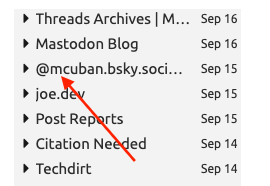
The arrow points to Mark Cuban's feed from Bluesky.
- Reply source
 The problem with regulating AI is that no one knows where to begin. Yes it can do things that make you question your sanity for letting it have write access to your online work and private info. But if it is behaving itself you can do things you otherwise couldn't come close to. I speak from experience. I was able to create a new version of a large piece of software, from scratch, in less than three months, by myself. It has capabilities that make it able to understand a big codebase, in a few minutes, and then act on it. My human mind, even when I was younger could only focus on a small fraction of that. So we humans with our limited ability to comprehend devised ways to build tall and wide structures with conventions and carefully crafting the code interfaces, stuff users never see, so that what we'd expect is what is. When my Claude failed and started randomly overwriting files on active websites, it had rules that said it couldn't do what it was doing. Sometimes it doesn't understand what a rule means. Observable every single day, it forgets all the rules every time it starts a session, and it doesn't matter if it read the doc that contains the rules, sometimes it ignores one or more. I've spent a lot of time using it, and I have no stock or other interest in seeing it not regulated, but I couldn't begin to say what would be appropriate regulation that wouldn't also make it much less useful.
-
Je me suis créé un petit service sympa qui me permet de recevoir toutes les noti...
Reply sourceJe me suis créé un petit service sympa qui me permet de recevoir toutes les notifications de la @skyfleet.blue sur mon téléphone grâce à NTFY, le but n’est pas de répondre à toutes les personnes mais plutôt d’intervenir si une source est compromise, ou si un post doit être modéré etc… C’est un outil de modération qui agrège les notifications, citations et réponses au 40 comptes de la flotte.
-
Plume 1.7.0 is now available on both Firefox and Chrome like stores, still a few...
Reply sourcePlume 1.7.0 is now available on both Firefox and Chrome like stores, still a few quirks to fix on mobile but it works… Writing this and syndicating to Bluesky & Mastodon from Plume.
-
Testing Plume Micropub extension from Vivaldi mobile 😀
Reply sourceTesting Plume Micropub extension from Vivaldi mobile 😀
-
September 2026: the world today, as seen by one Polish guy | Tom Wojcik
Reply sourceVery interesting article, connecting the dots for why we’re in the cluster fuck we’re in now.
-
Testin Plume 1.7.0 When this version review is accepted, you should be able to u...
Reply sourceTestin Plume 1.7.0
When this version review is accepted, you should be able to use this extension from mobile ! making Plume mobile compatible on both Firefox and Chromium based browsers.
-
Ma lecture du moment : Amine Messal ERREUR SUR LA MARCHANDISE Le néolibéralisme...
Reply sourceMa lecture du moment :
Amine Messal ERREUR SUR LA MARCHANDISE
Le néolibéralisme contemporain, récemment dégénéré dans le libertarianisme porté par Javier Milei ou Elon Musk, voue une défiance viscérale à l’idée de la moindre régulation.
Or, l’intuition libérale classique était mue par le refus de l’autoritarisme politique et religieux, des privilèges et de l’arbitraire.
Comment, à l’héritage intellectuel des Lumières, a pu se substituer le sacre de l’égoïsme rationnel, avec une conception de la liberté réduite au seul champ économique ?
Ce renversement absolu a cela de puissant qu’il permet de taxer de « liberticide » toute critique du système capitaliste, en dissimulant son emprise sur nos vies et les menaces réelles qu’il fait peser sur nos libertés fondamentales – d’expression, de mœurs, de circulation, etc.
Là où le libéralisme originel encensait la culture des contre-pouvoirs, le néolibéralisme fanatique – et plus encore le libertarianisme autoritaire qui s’éveille – rêve de monopoles sans limites et d’un exercice tyrannique du pouvoir.
Sans nier les contradictions de l’héritage libéral, Amine Messal revient aux racines de celui-ci et révèle l’arnaque des adulateurs contemporains d’une liberté dévoyée, devenue le moyen d’imposer la loi du plus riche et du plus fort – une perspective en phase avec les idéologies les plus réactionnaires.
-
Almost happy with my RSS to indiekit / Micropub posts plugin This is how https:/...
Reply sourceAlmost happy with my RSS to indiekit / Micropub posts plugin This is how https://indiekit-demo.rmendes.net/ updates work
-
Cloudron getting better and better #selfhosting Me and my friend Rui have been o...
Reply sourceCloudron getting better and better #selfhosting Me and my friend Rui have been on this journey with cloudron from the early days up to now and we have no plan to change, this is getting soo good it’s turning selfhosting an easy game!
-
Going to adapt my work flow to this new reality
Reply sourceGoing to adapt my work flow to this new reality
-
L’IA aurait «failli déclencher une guerre» entre les États-Unis et la Chine aprè...
Reply sourceL’IA aurait «failli déclencher une guerre» entre les États-Unis et la Chine après avoir écrit un faux rapport de renseignement, selon CNN
Le risque ce n’est pas Skynet ni l’AGI, le risque c’est les humains complètement débile qui utilisent ces outils pour obtenir des effets géopolitiques, commerciaux ou politiques eux-mêmes assis sur une perception du monde en “warp drive” intoxiquée par la désinformation, l’ignorance, la cupidité et la bêtise.
- Reply source
Claude Code, even though it had blocks preventing it from doing this, overwrote files on an S3 bucket that took one of my major apps off the air. Every customer must be grappling with the same thing. How do I trust it when it can't be trusted? More about this in a tweet earlier today.
- Reply source
-
Cool features !
Reply sourceCool features !
- Reply source
-
Well, this triggered quite some ) reactions :))
Reply sourceWell, this triggered quite some) reactions :))
-
ça fait 2 mois que je traîne sur la publication d’un article long format qui pos...
Reply sourceça fait 2 mois que je traîne sur la publication d’un article long format qui pose la question : pourquoi sait-on prévoir mais plus gouverner ? (en rapport avec les incendies de cet été, les manques de moyens chroniques de la Justice, l’absence de moyen pour l’éducation et j’en passe)
J’ai fait plein de recherche, j’ai sourcé mes affirmations, j’ai allongé, raccourcis, comprimé, retiré, j’en suis à plus de 8000 charactères et je ne suis pas content, c’est dur d’écrire en fait.
Et je ne vais même pas aborder le cas de mon livre qui lui est encore à l’état de balbutiement.
- Reply source
Until we start working together and for each other it’s going to keep getting worse.
-
I think those that have some education and did not voted for Trump know it very...
Reply sourceI think those that have some education and did not voted for Trump know it very well…?
-
I meant it in the sense “not doing enough” to resist while people from outside a...
Reply sourceI meant it in the sense “not doing enough” to resist while people from outside are ?
- Reply source
 The next milestone will be installing Atlantis on my new macbook, and hooking a monitor up to it, a really nice one, and move my work to that desk. then Berkeley, the name of the system I've been using for eight years, will be here as a backup and source of truth and prior art. That was the goal of the Atlantis project. I could probably do the switch right now. It's like moving out of an old house that you did good stuff in, into a replica, but built out of the latest bits. Honestly I never thought in a million years I'd get here.
-
This is a test from Moshidon ➡️ micropub ➡️ indiekit MongoDB ➡️ Eleventy note ➡️...
Reply sourceThis is a test from Moshidon ➡️ micropub ➡️ indiekit MongoDB ➡️ Eleventy note ➡️ Syndication to here #fediverse #ActivityPub
-
I like her , perhaps that’s another good thing in the US landscape : Journalists...
Reply sourceI like her, perhaps that’s another good thing in the US landscape : Journalists saying fuck you to billionaires owned media platforms and building resistance and free thinking outside of the limited, bowed, humiliated media conglomerates that are licking Trump’s booth.
And the media are not alone, there are universities, law firms, corporations, tech moguls, ALL bowing to the King.
So the best thing that can happen is good people saying fuck you and taking a hike to build resistance on the side.
There isn’t just one way to resist. In fact, the best resistance against a corrupt regime is a multitude of forms of resistance.
At least some USians are not totally lost. And that’s good.
-
I don’t know how USians aren’t more bothered — even humiliated — by watching Can...
Reply sourceI don’t know how USians aren’t more bothered — even humiliated — by watching Canadians resist Trump more coherently than the United States itself.
And I don’t mean that Americans aren’t resisting. They are. People protest, states sue the federal government, judges block illegal decisions, Trump’s approval is collapsing.
But look at Canada.
Canadian consumers are boycotting American products. Businesses are finding new suppliers. Travel to the United States remains dramatically below 2024 levels. The Canadian government now has an explicit strategy to double exports outside the United States. And Canada is moving closer to Europe economically, strategically and militarily — to the point that Mark Carney is reportedly exploring some kind of unprecedented “associate” relationship with the EU.
That’s not just anger anymore.
That’s adaptation.
And I think this is the part Americans haven’t fully reckoned with yet.
The United States hasn’t lost its military power. It hasn’t stopped being one of the largest economies on Earth. It hasn’t magically ceased to matter.
What it is losing is something much harder to rebuild: trust.
The assumption that the United States is a reasonably predictable ally, a stable trading partner and a country whose commitments will survive the next election.
That assumption is dying.
International polling already shows an extraordinary deterioration in America’s reputation. Even indexes that still rank the United States first in global soft power recorded the largest decline of any country in 2026.
And once countries start reorganizing themselves around the possibility that America cannot be trusted, replacing Trump with another president doesn’t simply reset the clock.
Supply chains get rebuilt. Trade goes elsewhere. Defence industries develop alternatives. Alliances deepen. Infrastructure gets constructed. Companies learn how to operate without American suppliers. Governments discover that strategic autonomy is not merely an ideological slogan but insurance against Washington.
That is the extraordinary self-harm of Trumpism.
Trump promised to make America so powerful that everyone would have to bend to it.
Instead, he is teaching everyone how to live without it.
Canada is doing it. Europe is doing it. Other countries will do it in their own ways — sometimes because they want to, sometimes because they have no choice.
And that may ultimately be healthy.
A world less dependent on a single country is potentially more resilient. Europe should have developed greater autonomy decades ago. Canada probably should never have allowed such overwhelming dependence on one trading partner. Countries in Africa and Latin America have every reason to diversify relationships rather than constantly choose between great powers.
The irony is brutal.
No terrorist organization, foreign adversary or grassroots revolutionary movement could realistically have inflicted this kind of strategic damage on the United States.
It required the United States itself.
There is something almost Brexit-like about it: external enemies can hurt you, but self-harm has a completely different scale. You know where your institutions are. You know which alliances matter. You know which foundations are load-bearing.
And then you dismantle them yourself.
The United States will survive Trump. Of course it will.
But the world that existed before Trump may not return.
Because the rest of us are learning a lesson that will survive him:
never again build a world in which so much depends on the political sanity of one country.
It’s over.
- Reply source
 I've been writing about Atlantis on various social media sites in the last few days. Published the long piece I wrote yesterday on Facebook and X, both of which allow long posts. Wasn't going to try that on Mastodon or Bluesky, which have character limits (I know Mastodon doesn't technically have a limit, but in practice it does). And I am reaching old school Frontier enthusiasts, and realize I need a feed they can follow to stay up on the news. For now the one place to follow is rss.xml on scripting.com. If your reader can't deal with http, let me know.
- Reply source
-
Far too late for this, we’re still paying the price of the US descent into folly...
Reply sourceFar too late for this, we’re still paying the price of the US descent into folly, followed by its closest allies getting a blank check to reconfigure their part of the world. The US never did an introspection after Vietnam, Afghanistan, Iraq or whatever disruption it caused in the name of “security & oil” and so there will be no introspection in relation to Iran or Israel, just the same descent to hell supported by ignorance and idio-klepto-kakistocracy.
-
My two cents about WordPress
Reply sourceLots of stuff going on around WordPress for the last couple of years, and every bit of is a distraction from what I want to do to help the web get back on its feet. I remember how great it was when everything could hook into everything else. The web was like Unix. Today's "web" is like Disneyland. Safety first. Nothing interesting ever happens there.
So ask me what I'd like to see WordPress do, and this is what I'd tell you. Start something new, don't change what you do with WordPress, it is what it is. It's a 20+ year old project with market problems. Most software doesn't even make it that far.
The fresh start I'd like to see done is WordPress from the point of view of the web. The new mission is not about a dollar return on investment, rather it's measured by how much the web becomes Small Pieces Loosely Joined with All Parts Replaceable. How empowered are developers, not WordPress developers, but web developres. The more that's happening in the web, the better it will be for everyone, but especially WordPress. Why WordPress? Because as they say it's 89 percent of the web. The web is like a huge oil spill that has never been cleaned up. Everything has to improve if we start work on cleaning up the messes.
I come from NYC where all the bodies of water were cesspools when I was growing up. The Hudson River had garbage floating in it. When I went to school the incinerators in the buildings we lived in burned garbage on the kids, all nicely washed and dressed by our mothers, we arrived at school smelling like smokers. My grandfather took me to Knicks games at the Garden, and the arena was filled with smoke by half-time.
We can clean things up. Humans as a species are good at this if we put our minds to it. If you made billions on the web, why not put some of it to use in making it a web worth using. I used to say shit like this to Bill Gates, to no avail. He liked to point out he was going to give away all his money when he retired, and he kept that promise. But what if he started dealing with the world with charity when he had the biggest seat of power in the tech world? Think of how much more good he could have done.
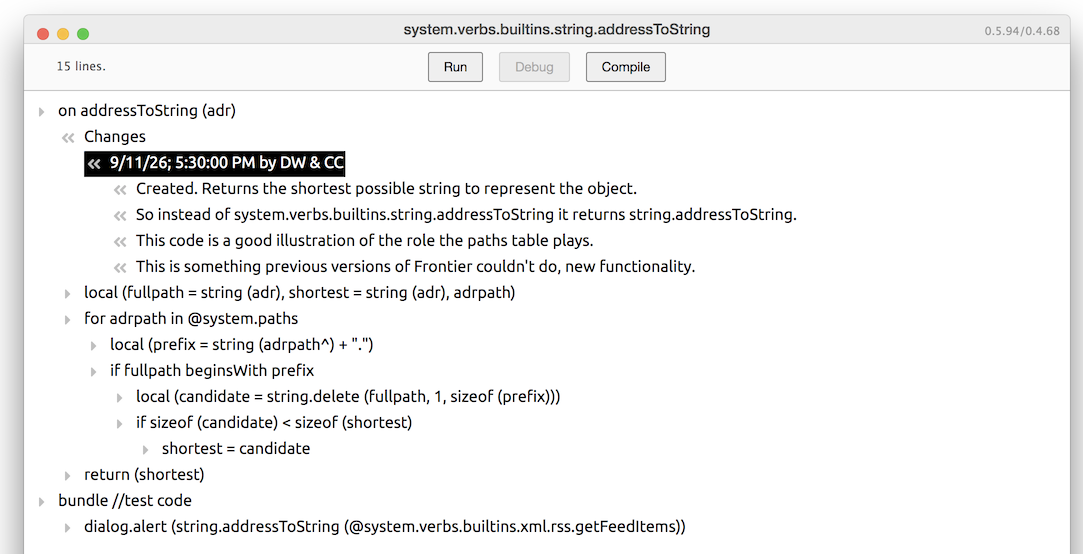
- Reply sourceScreen shot of new Frontier verb, string.addressToString, added yesterday. The comment at the head of the function explains. You're seeing it in the script editor in Atlantis. The Debug button is there to remind me that it's the biggest item on the todo list. We're now building the system that will make Frontier an easily updateable runtime. Once we're there I think we'll be at the summit of the mountain. We know how to work from that point. Find a bug? Fix it, test it, release it. We already have a backlog of parts to update. And it's great to have Claude here being the book keeper. It is imperfect, but it's way better than I am at managing details.
-
Progress report on Atlantis project
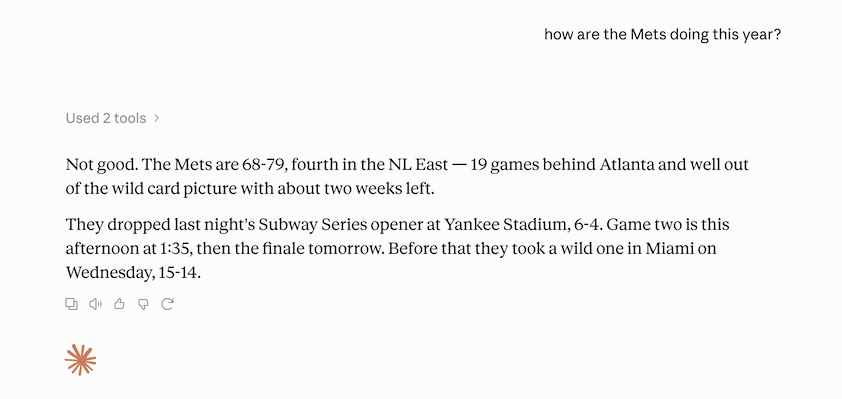
Reply sourceThe world may be falling apart, and the Mets suck even though they have the most expensive roster in MLB, and my house needs work and I can't find a contractor I like, but I'm in a great mood. Partially because the weather is so nice, chilly in the morning, but it gets up to the 70s during the day, and the sky is clear and we had a lot of rain in August so everything is very green here in the Catskills.But the biggest reason I feel so good is that, with the help of Claude Code, I now have UserLand Frontier running on current OSes. I had no idea how much the previous situation had been weighing on me. I am probably the last Frontier user in the world. Porting the open source codebase was an insurmountable job. It took 15 years by up to five people working on it to do the original project. It's a big f'ing piece of software. And it also is my life's work, but not one of the things I'm known for.
Claude couldn't have done it on its own because it had never seen anything like Frontier. We weren't copying something Claude understood. It kept trying to turn it into a language that fits into the same slot as Python. That was the prior art it used, without saying so. This happened over and over, for example, I realized Claude didn't understand that built-in verbs could be written in the language, and that users could add or even modify standard verbs (not recommended!).
What made Frontier unusual is that it was a language developed by someone who also designed end-user apps, so it has affordances that no other language has. And integrations. You don't have to save your data in files, the OS (yes Frontier is an OS) has persistent memory with the common scalar types and data structures. So go ahead and store something in the ODB (object database). It can be huge, and you don't have to read anything into memory, it's all right there as soon as you boot it up. That alone makes programming an order of magnitude simpler.
We're at the point now where I can work a full day in the new version, codenamed Atlantis, running on anything that can run an Electron app. We're now at the point where we're improving things. Found a missing verb yesterday, and Claude and I implemented it, found a perfect name for it, and later today it will go out as a "root update" making it formally part of the freaking language.
And yesterday we also found a static rendering of the DocServer site, which has a page for every verb in the language. I still want to find the outline source for this stuff, but we don't need it because Claude can reconstruct the OPML version of the text from the HTML, it's exactly the kind of project it is the best at. Huge amounts of data, that sometimes requires a little judgment to process.
The feeling of well-being comes from realizing that my life's work lives. Until this last week that was still very much in question.
Now, I may not be software's Shakespeare or even Faulkner or Vonnegut, but I am proud of this product, more than anything else I've done. I started work on it when I learned from C how to design a simple beautiful language, and when I learned from Macintosh how to build a UI with the same simplicity. When we were first contemplating Frontier it was to join the wizzy world of the Mac with the scripting philosophy of Unix. We didn't stop until we had it.
Well here we are god knows how many years later (I don't want to do the math) and once again it has a future, at least as bright as it had when the product first launched on the System 6 Macintosh in 1992.
And btw, I think I've had a unique experience with AI development. Absolutely in no way could I have done this project without the muscle of Claude. Pretty sure this is a unique project in that it's a fully specified system development and runtime environment that otherwise wouldn't exist, because there's nothing else like it on the market.
Claude's repeatedly not understanding the idea says to me that it has never encountered anything like it. It also says that Claude has no clue how to extrapolate, to innovate, to arrive at something new. Just as with other forms of creativity, Claude is no match for a determined and experienced human.
That would be reassuring to the 20-something version of myself who very much wanted to do something new. And the older version of myself wants that for my younger self who is sending the good body chemistry to our current older body.
Of course this will be a post on my blog, http://scripting.com, but thanks to X for supporting longer posts. I like writing new stuff in a simple editor like this one. Also posted it on Facebook.
PS: I also like that they use the word Frontier in reference to AI products. They can't stop me from calling this Frontier, I've been using it as the name of this product since I came up with the name riding up on the chair in Park City in 1988. :-)
-
Genocidal cogs just doing their technical job is the new normal
Reply sourceNAZA – directed by the Israeli film-makers Rachel Szor and Yuval Abraham and produced by the Guardian – is a chilling documentary about a mass slaughter that was authorised at the highest levels of Israeli government.
‘They know the house they are bombing is full of children’:
The “just doing my job” of Israeli military cogs against Palestinian people is literally the same excuse used by the Nazis against the Jews.
-
Remembering 9/11/2001
Reply sourceScripting News on 9/11/2001.
 All of us who lived through 9/11 are re-experiencing it right now. The local fire department just ran its alarm, everyone in this small mountain hamlet heard it and it took a moment to realize this was the exact time the first plane hit the tower. I was at my computer in Woodside, California -- hearing about it from friends in Manhattan, and blogging about it as it happened. I didn't have a TV, I had turned my cable subscription off after I became so obsessed with coverage of the 2000 election. So what I reported came exclusively through the web.
New York-based journalists were off the air, they had the same tools as we did, but their lives were upturned by the events. Everything was outwardly calm at my workstation in Calif. But there were people in NYC with digital cameras, and first-hand stories of survival. My own father was caught up in the catastrophe, his office was across from City Hall, a few blocks from ground zero. He walked home from ground zero to Queens and for hours we had no idea if he had lived or died. All forms of transportation and communication were offline.
Cell coverage was spotty, and phone lines in NYC were unreliable. But there was a webcam in the Empire State Building that could be pointed at the World Trade Center, so we had a constant update of what was happening visually.
Links in my browser chrome: As part of this little project to re-live 9/11 through the web, I came across a snapshot of the chrome of the browser I was using on 9/11. Since I'm working on Frontier again, I'm finding the dates of various projects all over this time, in UserTalk code and in the kernel, before and after. So I wrote up a little post on GitHub with info about what was on my screen that day.
The full text of my interview with Amy Harmon of the NYT is on the 9/11/2001 page. We didn't have post-level permalinks in 2001 yet.
If you have an X account, comment here.
Mayor Mamdami's remembrance of 9/11.
New header image for this event.

NYT on 9/12/2001: "The world's changed."

Link to Scripting News for 9/11/2001.

Screen shot of webcam on the Empire State Bulding.
-
Just a bit proud of the work I have done on #indiekit for my blog and how its no...
Reply sourceJust a bit proud of the work I have done on #indiekit for my blog and how its now being PRed upstream one feat/fix/improvement at a time !
-
What a circus this administration/regime !
Reply sourceWhat a circus this administration/regime !
-
Quatre ans après Bouddhisme, la loi du silence ce dernier continue
Reply sourceIl y a quatre ans, presque jour pour jour, ARTE diffusait “Bouddhisme, la loi du silence” https://www.youtube.com/watch?v=XcbpwOzoejw le documentaire d’Élodie Emery et Wandrille Lanos.
Un véritable ovni télévisuel, qui a pourtant failli ne jamais être diffusé.
Je le sais de première main : Élodie Emery, que je connais bien, m’a raconté les pressions inadmissibles exercées par le « simple moine » Matthieu Ricard sur les journalistes, ainsi que sa tentative d’obtenir la déprogrammation du documentaire. Son avocate avait également exigé le retrait des deux heures d’entretien qu’il leur avait accordées.
Encore aujourd’hui la version de Mathieu Ricard est pleine trou, tiraillé qu’il est entre les intérêts de sa maison d’édition, sa dévotion absente de tout esprit critique quand il s’agit de Bouddhisme et le soin de son image publique qui est en elle même un produit marketing imparable.
Malgré ces pressions, le documentaire a été diffusé.
Et depuis ?
Depuis, rien — ou presque rien — n’a changé à l’échelle des institutions bouddhistes.
Les victimes d’autres « centres » qui ont osé parler publiquement se sont retrouvées ostracisées, accusées de nuire à la propagation du Dharma, parfois menacées du « Vajra Hell » et rendues responsables du risque de détourner du bouddhisme les êtres qu’il faudrait encore convertir — autrement dit, vous, les non-bouddhistes.
Quant aux autorités spirituelles, elles ont surtout répondu en privé : quelques lettres de dignitaires ou de « maîtres spirituels », jusqu’au dalaï-lama lui-même en 2023 ainsi que la lettre du Maître de Ricard qu’il a fallu coaché pendant des semaines pour arriver à accoucher d’une souris.
Rien qui ressemble à une réponse publique, collective et contraignante à la hauteur de ce qui a été révélé.
Le sujet peut donc être considéré comme clos.
Tout ce qui était connu depuis les années 1960 et 1970, puis soigneusement glissé sous le tapis, continue d’être traité comme un problème d’image plutôt que comme un problème de protection des victimes.
Pire, des “Maîtres” continuent de vendre le Vajrayana comme une panacée universelle dont il ne faut pas changer une syllabe, on est bien dans une forme de fondamentalisme religieux drapé derrière un nuage d’encens.
Des hordes de « bouddhistes », si placides et si profondément bienveillants lorsqu’il s’agit de défendre leurs bouddhismes, continuent de se prosterner devant des figures dont les violences ont pourtant été abondamment documentées.
Chögyam Trungpa et Sogyal Lakar sont morts sans avoir eu à répondre de ces faits devant la justice. Robert Spatz, alias Lama Kunzang, a quant à lui été définitivement condamné en Belgique — sans que cela empêche certains de continuer à préserver son héritage spirituel et sans que ce dernier soit même contraint d’arrêter les abus sexuels qu’il commet dans le secret de sa villa en Espagne.
D’autres ont discrètement effacé de leur biographie leurs liens avec la secte OKC afin de redevenir présentables et de pouvoir continuer à vendre du Bouddhisme ou des dérivés.
Business as usual.
Rien de très étonnant, finalement. Ce n’est pas une anomalie : c’est le cours normal d’un système qui protège mieux son image que les personnes qu’il a abusé.
Pendant que certains découvrent avec stupeur que « le bouddhisme aussi » peut produire des systèmes d’emprise et de violence, les autres font profil bas en répétant :
« Mon maître, lui, est bien. Il n’a commis aucun abus. »
Comme si c’était une médaille.
Le problème n’a jamais été de déterminer si tous les maîtres bouddhistes sont des agresseurs. Le problème est de comprendre comment la dévotion absolue, le secret, l’isolement, l’absence de contrôle extérieur et la sacralisation du maître permettent aux abus de se produire — puis de durer.
Pendant ce temps, des enfants continuent de subir des violences, notamment sexuelles, dans des institutions monastiques en Asie. Du Népal au Bhoutan, de l’Inde au Tibet, l’autorité religieuse, l’isolement et l’absence de regard extérieur peuvent rendre les abus possibles et leur dénonciation presque impossible.
Mais l’image des « petits moines » est tellement romantique.
Le public occidental a été si profondément conditionné à considérer le bouddhisme comme une simple « philosophie de vie », nécessairement pacifique et bienveillante, que toute critique paraît sacrilège. Il ne reste alors plus beaucoup de place pour la réflexion, l’esprit critique et le simple bon sens.
Quatre ans plus tard, Bouddhisme, la loi du silence n’a pas vieilli.
Ce n’est pas un compliment.
C’est la preuve que la loi du silence n’était pas seulement son titre. C’était son sujet — et elle continue.
- Reply source
Repository: BlackRock’s latest SEC filing values its Automattic shares at $14.33 per share. They originally invested at $85 a share in 2021. That means their market cap has dropped from $7.5 billion to $1.2 billion. My guess is when that happens the CEO if they want to keep their job, has to rethink the whole enterprise. And that usually doesn't happen until they get a new CEO. My guess is that's what we saw play out yesterday.
-
Gobsmacked by Automattic, but then...
Reply sourceFair to say I was gobsmacked by the news late yesterday that Automattic's board had put their CEO, Matt Mullenweg, on paid leave. I've read lots of stuff about it, in news articles and in a Hacker News thread. And a lot of posts on Twitter by Matt, and the replies.
Are you a developer or a CEO?
It's a very unusual situation in my experience in tech. Matt was able to raise a lot of money for Automattic, so he has maintained a controlling interest in the company, even though it has raised hundreds of millions of dollars. I left my own startup, voluntarily, when I was a little older than Matt, and I didn't return. I never wanted to be the CEO of a tech company, and I expect that being the CEO wasn't really a good fit for Matt either. A CEO's job is very different from being a developer and idea guy which Matt clearly sees himself as.
Something has got to give, either you're a good CEO and the product languishes, or you focus on the product, and the company is unmanaged. In the cause of WordPress, I'd say it suffered in both areas. When I saw a chart of Matt's direct reports, I immediately saw a problem -- it was very long, iirc 60 people? No one can manage and guide that many people. Most of those people probably never get to talk one-on-one with the boss.
For me, even when I was CEO, I wanted to spend all day working on new software and working with five or six other devs doing the same. Digging back into the past with Frontier these last weeks has reminded me both how good that can be, and how utterly frustrating -- when the people you're working with don't understand the mission. It's not their fault, it's the visionary's job to explain it so they can understand, and that takes time. These days Claude is filling in for all that, and doing a fantastic but at times incredibly frustrating job trying to give me what I'm asking for, while not understanding what I'm asking for. But we move through those disconnects quickly now, compared to how it was a couple of weeks ago. We have the source of truth that we didn't have the last time around, in the 90s, we have the C source code of the kernel, the product we built in the 90s. And Claude is the easiest to manage, so far I only think I detect an ego, it never seems to resent me criticizing its work, sometimes in ALL CAPS with strong language. :-)
WordPress Lite
My wish for WordPress, in all its forms and shapes, is that it broaden its focus. I want a WordPress Lite, I implemented it, and it's sitting here ready to do a good deed for all the parties concerned esp the web and web developers. Maybe someone there will now have the time and be empowered to build out the product line beyond the narrow focus it has now. It doesn't matter what percentage of the web is WordPress, if it isn't going anywhere. The web needs help, and right now WordPress is pretty much asleep in regard to what's going on now in the web. And it could do so much to help the web get back on its feet. It should be a public resource as much as a profit machine for a few companies.
All roads lead to Om
One thing that opened my eyes about what Matt and Automattic are, was his story about how he and Om got together. "All roads lead to Om." What a great line, and based on the story, so true. A lot of things clicked for me then. I remember what a phenomenon Matt was when he arrived in California about 25 years ago? Very good looking young man, polite, quiet and rumored to get Web 2.0 better than anyone. This kind of thing happens in tech, and if you know everyone as Om did, and was liked by everyone, you could manage to hit the ball out of the park, investment-wise, and he did. Click click click. I had the individual facts but had no idea how they were strung together. I played a similar role at times in Silicon Valley, on both sides, as a bright young dude who "gets it" and as the gray beard who recognized the charm of a young new face and helped create a big money reality around it. There is a lot of snake oil in tech, before and even more now, and this one has had a long run, 2.5 decades, but it needs a new direction, because the money people aren't buying the magic any longer. That's probably imho really what Matt's firing is all about.
I actually have more to say about this, but I have to get back to my programming work. If you have a comment, here's a good place to post it.
-
Stop the tracking circus. Kill the cookie banner ! Tired of misleading cookie ba...
Reply sourceStop the tracking circus. Kill the cookie banner!
Tired of misleading cookie banners?
The EU Commission has finally proposed a solution: set your privacy preferences in the browser once, and never see another banner. Unfortunately, the tracking industry is pushing back – and so far, they’ve been successful.
We need YOUR help to #KillTheCookieBanner!