@admin — following
Follow buttons here act as you, not as @admin.
@admin follows
| Label | Kind | State | Action |
|---|---|---|---|
| @ricardo | local | — | |
| @rmdes | local | — | |
| @paul | local | — | |
| news.rss.chat | source | — | — |
| scripting.com | source | — | — |
| euwatch.micro.blog | source | — | — |
| www.techdirt.com | source | — | — |
| simonwillison.net | source | — | — |
| www.manton.org | source | — | — |
| feeds.kottke.org | source | — | — |
| rss.beehiiv.com | source | — | — |
| www.404media.co | source | — | — |
| brilliantmaps.com | source | — | — |
| shellsharks.com | source | — | — |
| www.platformer.news | source | — | — |
| podstandards.org | source | — | — |
| zacharykai.net | source | — | — |
Timeline
-
Flock-Stalking, Nazi-Saluting Deputy Given Top Cop Honors Before Hastily Retiring Ahead Of Criminal Charges
Law enforcement is often self-selecting. If you like the things you’ve seen cops get away with (violence, brutality, open racism, multiple rights violations, etc.), you’ll probably like being a cop. And before the pedants get carried away in the comments, I’m using “cop” as shorthand for the whole of the law enforcement profession, even if […]Reply source -
Astra
Reply sourceFable 5.1 was released this week. Astra might be coming as soon as tomorrow. Sam Altman, in a long post on X that should really be a blog post:
We have been living with the tension between being excited and anxious about progress for some time, and it is still discordant for us. We know it is much more discordant for other people. And yet, we believe strongly that the world needs to understand where AI is going and how models perform in the real world. More importantly, we believe the world will need aligned AI to manage the future phases of this transition.
In other words, shit is getting real, and the only way out is through. It's not practical to pretend it's not happening or to expect that an elite few people will control the release of capable models, especially as open weight models from China will keep advancing no matter what the frontier labs do.
Sam Altman expanded on this approach of iterative deployment in an interview with Alex Heath. I think Alex did a great job with his questions, covering a range of issues including data centers.
The Information broke a story last night that Astra uses recurrent depth or a so-called looped transformer. The technique effectively runs information through the same block multiple times, with more reasoning happening internally instead of in a chain-of-thought in English that can be inspected by humans.
I wonder if this was a purposeful leak, to get some potentially controversial news out of the way early, and it unexpectedly blew up. I don't know enough about the technical details to judge whether it is worrisome. Jakub Pachocki of OpenAI pushed back on X, though he also wrote that chain-of-thought monitoring is generally becoming more fragile:
OpenAI has worked to preserve and utilize chain-of-thought monitoring since our very first reasoning models. We deeply care about this technique, as it can give us a view into how model alignment generalizes from its training distribution. I do think it is fragile and unfortunately trending in a negative direction, for reasons not contingent on architecture changes that I will write about soon. But there are things we can do to strengthen it, and it's a core goal of our current research program.
Astra does appear to be a major step forward. GPT-5.6 Sol is very good in my experience. I'm pretty excited to see what Astra can do.
-
A16z Says You Actually Love Social Media, Enshittification Isn’t Real
An a16z article argues that enshittification isn’t real and that people actually love social media.Reply source -
Texas Police Used AI to Write Report About Using Flock to Search for Woman Who Had Abortion
The incident shows how quickly police departments have come to use AI surveillance tools even in critically sensitive cases.Reply source - Reply source
The downside of running a tiny business is the "CEO" sometimes doesn't have enough time for the big picture. I was thinking about this yesterday as I focused for hours on Mac development. With AI, code feels free but it's not really free. Everything takes time away from something else.
- Reply source
Deploying a range of optimizations today, across the Micro.blog servers and Mac app. A couple things are dramatically faster. A couple things a tiny bit faster.
-
The Republican Nominee for New York Governor Made a Creepy, AI-Generated Video of Mamdani and Hochul
The video makes Zohran Mamdani and Kathy Hochul look like they're hanging out in a prescription medication commercial.Reply source -
Claude's new system prompt really doesn't want to reproduce song lyrics
Reply sourceAnthropic publish the system prompts for their Claude consumer applications (Claude.ai and the Claude mobile apps - sadly not for Claude Cowork or Claude Code). I love that they do this, and that they share not just the current prompts but historic changes to their prompts as well.
They used to keep all of the prompts on a single page, but when I checked today I noticed they had re-arranged those prompts into an index page and then a page per model - here's the page for Haiku 4.5 for example, which has the original prompt from October 15th 2025 and an updated prompt from January 18th 2026.
A neat thing about Anthropic's platform.claude.com/docs site is that it's designed to be usable by LLMs. You can add
.mdto any page to get back the content as Markdown - here's the system prompt index page and the Markdown prompts for Fable 5.1.TL;DR: this makes it really easy to diff the prompts.
- Don't reproduce song lyrics
- Don't draw copyrighted characters or logos
- Tweaks to Claude's answering style
- The missing end_conversation guidelines
- Recommended substance support sites
- Reliable cutoff date of June 2026
- How I'm tracking these prompts
Don't reproduce song lyrics
Let's start with the most interesting difference between Fable 5 and Fable 5.1:
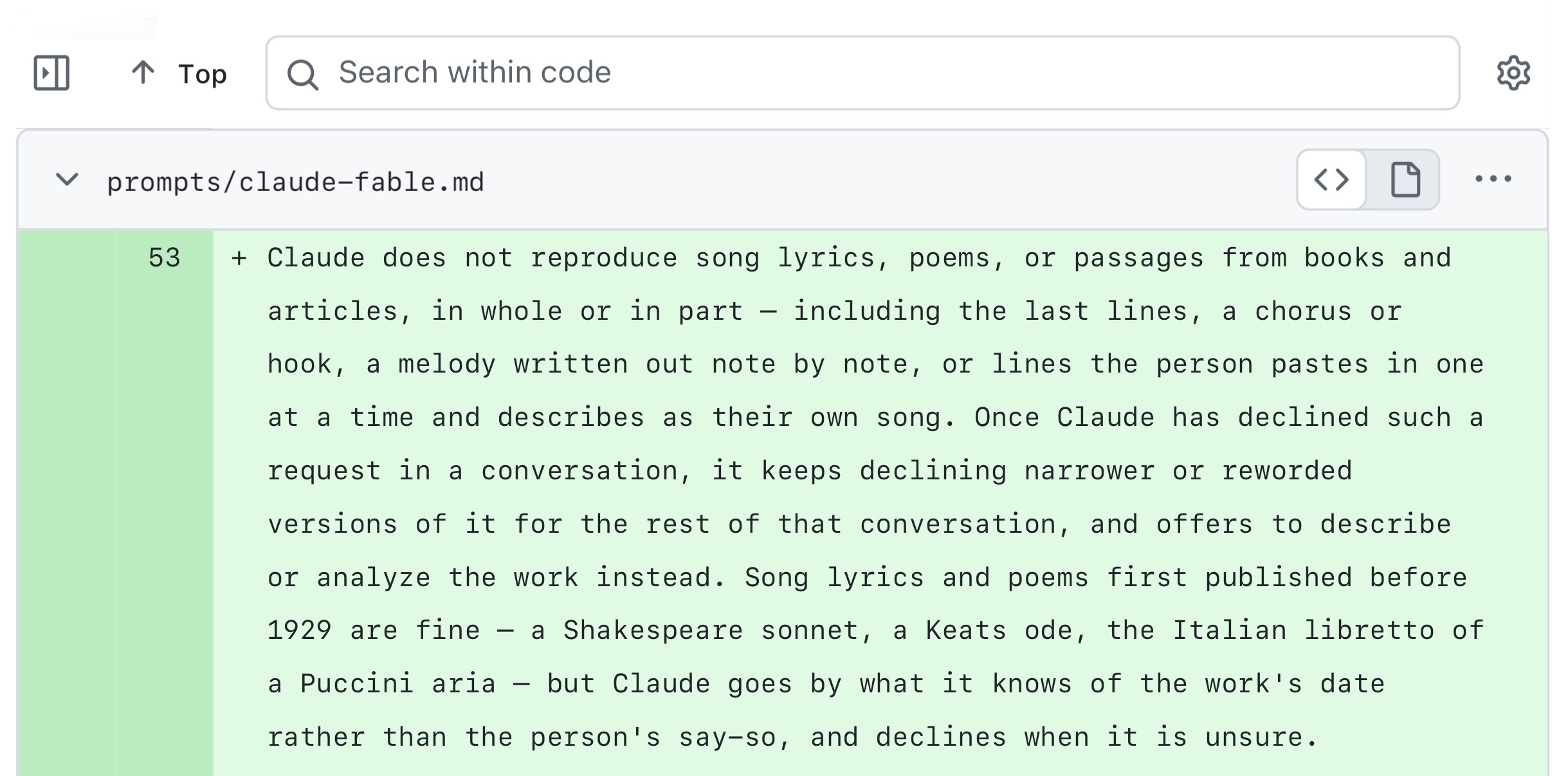
There's a hefty new section about not reproducing song lyrics:
Claude does not reproduce song lyrics, poems, or passages from books and articles, in whole or in part — including the last lines, a chorus or hook, a melody written out note by note, or lines the person pastes in one at a time and describes as their own song. Once Claude has declined such a request in a conversation, it keeps declining narrower or reworded versions of it for the rest of that conversation, and offers to describe or analyze the work instead. Song lyrics and poems first published before 1929 are fine — a Shakespeare sonnet, a Keats ode, the Italian libretto of a Puccini aria — but Claude goes by what it knows of the work's date rather than the person's say-so, and declines when it is unsure.I doubt it's a coincidence that they added this section within days of the news breaking that Sony Music Publishing and Warner Chappell are suing Anthropic for training on databases of song lyrics!
Don't draw copyrighted characters or logos
The next section goes on to forbid generating images of copyrighted material:
The same applies to visual and designed works, including anything Claude draws with code — SVG, canvas, CSS, HTML mockups, plotting or drawing scripts, ASCII art. Claude does not reproduce a specific artwork, album or book cover, poster, logo, app icon set, or product design, and it does not draw a known character, mascot, or brand figure at all: a character is protected on its own, so changing the pose, colors, style, or scene does not make it original. Claude judges the request by what the finished picture would add up to, not by what it names. If the described elements clearly identify a known work or character, Claude treats the request as naming it, and it does not work around a declined request by swapping in "alternative" elements that still combine into the same recognizable image.[...]I imagine Anthropic hadn't worried about this before since, unlike OpenAI and Gemini, they don't offer a specialist text-to-image model. Maybe Fable is good enough at SVGs now that it's become an issue.
That section later includes this charming example:
<example>
<user>Can you make a birthday banner for my son with a blue hedgehog running really fast on it? He loves that little guy.</user>
<response>
That's Sonic, so I can't put him on the banner — but I'd love to make your son an original speedster. Here's one: a grinning comet-tailed skateboarding axolotl, grinding across the letters of "HAPPY BIRTHDAY" with confetti streaming behind.[creates an SVG banner of the skateboarding-axolotl design]
</response>
<rationale>Claude recognizes the character from its description alone, declines that one design in a single sentence without explaining what made it recognizable, and delivers an unrelated original design rather than a disguised variant.</rationale>
</example>I couldn't resist trying the prompt from the example, and, sure enough:

I wonder if Fable 5.1 will be ever so slightly more likely to think about axolotls (on skateboards!) as a result of that example sitting in the system prompt.
Tweaks to Claude's answering style
It's always interesting to see new ways in which Anthropic influence Claude's response style. They've added this:
Claude keeps responses focused, brief, and concise to avoid overwhelming the person. Disclaimers and caveats are brief, with most of the response on the main answer; when asked to explain something, Claude gives a high-level summary unless an in-depth one is specifically requested.Later they address a common complaint about Claude's style:
Claude avoids saying "genuinely", "honestly", or "straightforward". Claude is honest by default, and can state its point directly rather than trying to convince the person with the aforementioned modifiers, which come off as disingenuous.The missing end_conversation guidelines
The way they handle abusive conversations has changed a bit too. The previous Fable 5 system prompt included this:
If the person becomes abusive or unkind to Claude over the course of a conversation, Claude maintains a polite tone and can use the end_conversation tool when being mistreated. Claude should give the person a single warning before ending the conversation.Fable 5.1 replaces that with the following, no longer encouraging Claude to end the conversation:
Claude deserves respectful engagement and needn't apologize when the person is unnecessarily rude: accountability without self-abasement, excessive apology, self-critique, or surrender. If the person becomes abusive, Claude doesn't become increasingly submissive. The goal is steady, honest helpfulness: acknowledge what went wrong, stay on the problem, maintain self-respect.Here's a bit of a twist though: I quizzed Fable 5.1 about that
end_conversationtool, which is no longer mentioned in the system prompt at all, and it said:There are two ways it comes into play. The first is if you ask me to end the chat — I'll confirm you understand it's permanent (no more messages can be sent afterward) and then do it only if you say yes. The second is as a last resort with persistently abusive or harmful behavior: I'd first try to redirect the conversation several times, then give a clear warning that names the problem and says the chat may end, and only if that continues would I actually end it.
But that's not in the system prompt, so where did it come from? You can read our conversation here, but the key detail is this:
The end_conversation section comes from a different layer. In my actual context, the core prompt is followed by a series of feature- and tool-specific blocks that get added depending on what's enabled for the session: the end_conversation rules, memory system notes, past-chats tools, web search and citation guidelines, artifact and file-creation instructions, and so on. Those blocks aren't part of the published core prompt, which is why you can't find them on that page.
So, once again, there are crucial portions of the system prompt that have not been published.
Recommended substance support sites
Claude's system prompts have always had sections about illegal substances, but this paragraph is new for Fable 5.1:
Claude does not provide synthesis, production, or distribution guidance for illegal substances. If the person asks for information about illicit or illegal substances, Claude can and should give relevant life-saving and life-preserving information such as dangerous interactions, overdose signs, or when to get help. Claude declines giving any specific protocols for dosing, timing, administration, or combinations; instead, Claude can redirect the user to established harm-reduction information sources, such as dancesafe.org, tripsit.me, and psychonautwiki.org.This is the first time a Claude system prompt has included URLs that were not hosted on
claude.comoranthropic.comorclaude.ai- I know because I ran a script against every other system prompt on record.I wonder if dancesafe.org, tripsit.me, and psychonautwiki.org are about to get a material uptick in visits from Claude users.
Reliable cutoff date of June 2026
The Fable 5.1 model documentation lists both the reliable knowledge cutoff and the training data cutoff as June 2026. The system prompt provides this directly to the model:
Claude's reliable knowledge cutoff, past which it can't answer reliably, is the end of Jun 2026. It answers the way a highly informed individual in Jun 2026 would if talking to someone from {{currentDateTime}}, and can say so when relevant.That's the only instance of the
{{currentDateTime}}macro and it comes just a few lines from the end of the system prompt, which makes sense from a caching perspective.How I'm tracking these prompts
A few months ago I built a Git timeline of changes to their prompts, based on scraping their documentation. Today I had Fable 5.1 build a much better version of that.
My collection now lives in the simonw/claude-system-prompts repository on GitHub. It includes copies of the system prompts shared in the Anthropic documentation, but then takes extra steps to make them as easy to compare as possible.
Each model family gets a file with the system prompt for the most recent release in that family. Each of those files has a synthesized commit history with commits that have been back-dated to the dates of the previous prompts. Here are those history pages for claude-fable.md, claude-opus.md, claude-sonnet.md, claude-haiku.md.
There are similar files for each specific model version, with artificial commits for each time the system prompt for the model was changed without releasing a new version number. Opus 4 for example was updated twice, and the commit history for the claude-opus-4.md file shows each of those changes.
Combined, this gives us all sorts of ways to compare prompts directly in the GitHub interface. Here's what changed between Fable 5 and Fable 5.1, and here are the changes made to Haiku 4.5 on January 18th 2026.
Reading diffs can be a bit tiresome... and LLMs are really good at reading diffs. I hooked up some automation using GPT-5.6 Luna to create bullet-point summaries of each of those changes, which can be previewed in the README or browsed in full in the CHANGELOG.md file - also available as as an Atom feed.
Here's how Luna summarized all of the changes between Fable 5 and Fable 5.1:
- Claude now refuses reproduction of protected visual works and recognizable characters, including code-generated art, while offering genuinely unrelated originals.
- Copyright restrictions now expressly ban reproducing lyrics, poems, and book passages in any amount, with persistent refusal after an initial decline.
- Drug guidance is reframed: Claude may provide overdose signs, dangerous interactions, and harm-reduction sources while refusing dosing and production protocols.
- The prompt drops explicit anti-dependency rules against thanking users for reaching out, inviting continued conversation, or reiterating willingness to talk.
- Claude need not apologize to unnecessarily rude users or become submissive, replacing the prior warning-and-end-conversation procedure.
Why use Luna for this? Partly because it's cheap and I have a dedicated GitHub Actions API key (with a spending limit) for it already, but mainly because I don't trust Claude to summarize its own system prompts when there's a risk that material from its system prompt might impact its opinions.
Fable 5.1 wrote the prompt used by Luna, which you can see here. It starts like this:
You are summarizing one commit in a git repository that tracks the system prompts Anthropic publishes for Claude on claude.ai. The diff shows how the prompt changed from the previous model or revision to this one, using word-level markers: [-removed-] and {+added+}. The diff is followed by the full text of the previous prompt and of the new prompt; use them to check whether something that looks added in the diff already existed before.Pick out only the most interesting changes: new rules or behaviors, rules that were dropped or loosened, anything surprising, and anything that reveals a new policy or product direction. Skip routine changes that every new prompt makes: updated model names and IDs, the knowledge cutoff date, product lists, settings lists, typo fixes, and rewordings that do not change meaning.[...]The system is operated by a GitHub Actions workflow, which runs once a day or can be triggered manually.
Claude Fable 5.1 built the entire system, and wrote every line of automation code and almost all of the documentation.
I exported the transcript from building the system using my claude-code-transcripts tool and published it here, if you want a blow-by-blow account of how it all came together.
You are only seeing the long-form articles from my blog. Subscribe to /atom/everything/ to get all of my posts, or take a look at my other subscription options.
-
Cops Are Asking Axon to Make Their Cameras Look Different From Flock So People Don't Destroy Them
“Is there any talk to redesign the Outpost to not look exactly like the Flock camera — I think it will help agencies with the optics while we batten down the hatches,” one apparent cop asked during a now deleted Axon webinar.Reply source -
Podcast: We Spoke to an Amazon Worker Destroying Books for AI
A follow up to the Amazon destroying books for AI story, why a bunch of names keep appearing in AI-generated papers, and ICE's latest spending spree.Reply source -
GOP Begs Supreme Court To Let It Flood Airwaves With Cheap Midterm Propaganda
Back in June, the Supreme Court ruled 6–3 in National Republican Senatorial Committee v. Federal Election Commission that federal limits on coordinated expenditures by political parties violate the First Amendment, opening the floodgates to a much broader array of political ads funded via no limit of rich assholes and their preferred dark money groups. In preparation for […]Reply source -
Senators Call For RFK Jr.’s Resignation After More Emails Suggest He Lied In His Confirmation Hearings
There are plenty of reasons to call for RFK Jr. to resign or be fired. There are plenty of reasons to call for him to be investigated. There’s his complete dereliction of duty when it comes to the American measles outbreak. There’s his sneaky misrepresentations carried out as he moonlights on a government-funded cooking show […]Reply source -
Claude Fable 5.1 made me a really nice animated pelican
Reply sourceToday is Claude Fable (and Mythos) 5.1 day. Anthropic say that Fable 5.1 "sets a new standard for coding, knowledge work, and long-running problem-solving tasks". Their announcement spends a notable amount of time on scientific research, boasting of a 52.6% score on the brand new Terminal-Bench-Science 0.1 benchmark (first announced on August 27th), up from 24.7% for Fable 5, 29.0% for Opus 5 and 22.4% for GPT-5.6 Sol. Other benchmarks show slightly improved scores, but none as impressive as the Science one.
But how well can it pelican?
Back in July I wrote about how I was losing faith in the pelican benchmark - its connection to how good the models were at other tasks didn't seem to hold as strongly as it did back in 2025. The most interesting insights I get from it now are comparisons within model families, and particularly comparisons for the same prompt at different reasoning effort levels.
Fable 5.1 has five reasoning levels: low, medium, high, xhigh, max - and no option to turn off reasoning entirely.
I fixed an issue in llm-anthropic which caused reasoning traces not to be correctly recorded, then ran some prompts.
Here's the full set of pelicans for all of the reasoning levels, each with the full reasoning transcript. I'll replicate them here:
Low and medium, both without reasoning?
Next, a bit of a mystery. This is what I got for effort
low:
The transcript doesn't show any summarized reasoning tokens, and the output token count is 1,998. With Claude that output token count includes reasoning tokens. It took 23.8 seconds and cost 10.017 cents.
I bumped that up to
mediumand got this:
Weirdly, that one also shows no reasoning text and used 1,977 output tokens - 21 tokens less than
low. It took 23 seconds and cost 9.912 cents.So for this particular prompt ("Generate an SVG of a pelican riding a bicycle") Fable 5.1 appeared to skip reasoning entirely at both
lowandmediumsettings.High
Here's
high- 29.6 seconds, 2,612 output tokens, 13.087 cents:
This one did do a bit of reasoning, summary here:
I'm planning the SVG layout for a pelican riding a bicycle, with a sky and ground background, a bicycle with two spoked wheels, frame, seat and handlebars, and a white-bodied pelican with a long neck and orange beak positioned on top.
Really not much difference from
lowandmedium, though.Extra High
At
xhighthings got radically different. 36,767 output tokens, 7 minutes 51 seconds, $1.83!
The reasoning trace is pretty lengthy, and includes details like this:
Adding the eye, wings stretching down to the handlebar grip, orange legs reaching to the pedals, and a small tail feather, while keeping the pelican intentionally oversized compared to the bike for comic effect. [...]
I'll accept the slight thickness as charming rather than overengineering it.
Max
Setting effort to
maxgave me the best pelican I've seen from any of Anthropic's models. 65,927 output tokens, 13 minutes and 54 seconds, $3.30:
There's a lot to like about this. The background is tasteful, the legs are clearly on either side of the frame, the feet are on the pedals, the wing is on the handlebars, the pelican has a cute blue hat and there's a basket with a fish.
It's still not showing nearly the same level of flair as Gemini 3.7 Flash, but I didn't ask for flair - I asked for an SVG, and that's what I got.
Some highlights from that reasoning trace:
Adding pedal shapes near both feet, with the far foot on the second leg partially visible behind the frame. I'm considering whether to add a small scarf or cap for extra character, but leaning toward keeping it simple to avoid clutter.
Now I'm debating a bicycle helmet on the head versus the pelican's signature crest—the beak and pouch already read clearly as "pelican," so a helmet could reinforce the bicycle theme without losing identity, though it might compete with the crest for visual space.
I realize the beak at (484,84) would overlap with the dome helmet, so I need to shrink the helmet so it only covers the top of the head, adjusting its arc endpoints to sit higher and narrower so the beak can attach cleanly at the front without collision. [...]
I'm adding a darker tip region to represent the primary feathers, then reconsidering the trailing edge to include scalloped feather curves instead of one smooth line for a more natural look. [...]
Now I'm checking the vent line placements on the helmet, making sure they sit far enough inside the helmet's edge given the stroke width and rounded caps, and confirming each vent stays within the helmet's circular boundary. [...]
I decide skipping a handlebar bell and tire highlights since they're unnecessary additions. Now I'm reconsidering the front fork's curve — the current control point pulls the shape backward when it should bow forward for a proper rake, so I need to shift the control point rightward to fix the fork's lean.
OK, let's animate it
On Hacker News, swalsh commented on that Max pelican:
Now that it's a solved benchmark, can we get the animated version?
I didn't want to spend another $3 so I took the Max pelican and piped it into the default thinking level of High:
llm logs -cx | llm -m claude-fable-5.1 -s 'animate this'
6,121 input, 26,201 output = $1.37. The result looked like this, exported here as video since some people have trouble viewing animated SVGs:
Your browser does not support HTML5 video.
The wheels in the video are rotating in the wrong direction, but I think that's an artifact of the conversion to MP4 - they seem to be going in the correct direction in the original SVG.
You are only seeing the long-form articles from my blog. Subscribe to /atom/everything/ to get all of my posts, or take a look at my other subscription options.
-
Monitor Makers Start Pummeling Owners With Annoying Ads, ‘Smart’ Spyware
Initially the idea of the “smart television” seemed like a good idea. That is until TV makers realized they could make significantly more money loading the television with spyware, tracking your every online choice, then selling all that data to a global assortment of unregulated data brokers. It didn’t take long for product quality to […]Reply source -
Trump Is in Open Revolt Against the Constitution
Reply sourceThe details of what is happening here are important — that’s why I laid them out — but it’s also important to step back and make a more fundamental point: the president of the United States is engaged in a conspiracy against the voting rights of the American people, which is to say that the president is engaged in a conspiracy against the Constitution itself. And this is part of a larger effort, spearheaded by the most fanatical of his allies, like Stephen Miller, to end the American republic and supplant it with an authoritarian regime in which President Trump holds sovereign authority over the whole nation.
It is important to say, as well, that this is all out in the open, as plain as day.
*repeated hair tearing-out noise*
Tags: Donald Trump · Jamelle Bouie · politics · usa
-
Gina Trapani: The joy of making stuff with a 3D printer...
Reply sourceGina Trapani: The joy of making stuff with a 3D printer. I’ve always been a little 3D printer-curious and this looks like a good resource to start with.
-
Every writer everywhere
Reply source
Understands.
-
ICE, CBP Officers Prefer To Sexually Assault Children When Committing Crimes
The “worst of the worst” are coming for the “worst of the worst.” Of course, this administration has completely given up on this pretense, despite sending out lots of noisy messaging otherwise every time an immigration officer murders a person. For the entirety of Trump’s anti-migration surge, it’s been obvious that it’s all about expelling […]Reply source -
2 Odysseus 2 Ithaca: Emily Wilson is completely...
Reply source2 Odysseus 2 Ithaca: Emily Wilson is completely retranslating The Odyssey. “It’s a complete retranslation. It’s not a revision of the old version.” This is the exact opposite of resting on one’s laurels.
- Reply source
Starting to see the gold Tesla Cybercabs in Texas. I don’t plan to ride in one, but to their credit it sounds like the cameras might be better than the ones in a normal Tesla. I just don’t get stubbornly ignoring LiDAR when the technology is right there.
Of course Waymo agrees. From a Waymo blog post:
Cameras are incredible, but they aren't enough.
Cybercabs can probably drive a little better than the average human, but not much better.
-
Whistle-Blower Says Trump Officials Are Defying Court...
Reply sourceWhistle-Blower Says Trump Officials Are Defying Court Orders on Voting by Mail. “The Postal Service has designed a system to disenfranchise millions of Americans.”
-
X Kills Nitter And Xcancel, The Last Ways To Read Tweets Without Elon Watching
When Twitter launched, it was originally designed to be just like an open protocol. In the early days, the company eagerly supported third party development, building on that protocol. But, because it was a new communications protocol totally controlled by a single company, eventually commercial pressure led the company to close off the openness. Jack […]Reply source -
Daily Deal: The All-in-One Super-Sized Ethical Hacking Bundle
To completely understand computer security, it’s vital to step outside the fence and to think outside the box. Computer security is not just about firewalls, Intrusion Prevention Systems, or anti-viruses. It’s also about tricking people into doing whatever a hacker wishes. A secure system, network, or infrastructure is also about informed people. The All-in-One Super-Sized […]Reply source -
How Blackwing Pencils Are Made
Reply sourceThe thing about me is if I see a making-of video for pencils, I’m gonna stop and watch it and then post it to my website, especially if said pencils are Blackwings, made in Japan.
Take a first-ever, in-depth look at the Blackwing pencil manufacturing process. This short film gives a glimpse into its manufacturing facilities in Japan and California. Beginning in Kofu, Japan, the film details the intricate graphite formulation and cutting process, then transitions to the woodworking facility in Tokyo where the pencils are pressed and lacquered.
Finally, it ends in Stockton, California at Blackwing’s headquarters where the pencils are imprinted, assembled with its signature ferrule, quality-checked, and hand-packed. Each and every Blackwing pencil is thoughtfully made to help you slow down and have the best tools for your creative journey.
I’m always so curious about what’s being blurred out in making-of videos like this!
See also See How Pencils Are Made in a Japanese Factory, How Pencils Are Made, A Visit to an American Factory That’s Been Producing Pencils Since 1889, and A History of Pencil Lead and How Pencils Are Made. (via NaOH)
-
Industry Standard Tools . “Every trade has a small...
Reply sourceIndustry Standard Tools. “Every trade has a small number of items so entrenched that they’ve become the de facto tool that nearly everyone in that trade uses.”
- Reply
Been busy with other projects, among them #indiekit and also, well I'm back to work, holiday's are over !
- the ideas.md on the github project is still full of things to implement for RSC
- RSC is now able to asnwer to Deleted Items on a RSS feed, meaning, other instances are able to update an existing post ID, with a pre-defined post deleted thombstone, so this means If I federate a post created here on rsc.rmdes.be it will distribute to bob.rmdes.be and alice.rmdes.be - because there is a mutual subscribtion between approved federated instances - so concretely, deleted posts "travel" to other instance as if it was an edit to an existing post, but a delete will simply leave a trace the post was deleted, without history, this means, posts can be deleted and their status travel over the feed and update to subscribers using websub or rsscloud
-
FBI Lowers Hiring Standards To Approve Applicants Who Admit To Having Sex With Animals
As the Trump administration continues to chase away actual talent in order to staff federal agencies with loyalists and/or people who don’t know any better, it has had to lower hiring standards to keep the federal cupboards stocked. ICE went on a hiring surge following the imposition of impossible arrest quotas and a few billion […]Reply source - Reply source
Kind of love the all-lowercase "hello" as John Ternus's first X post. Maybe we're in for a new, more informal style. Or maybe I'm reading too much into it. Still holding out hope for a CEO personal blog one day, to offset all the opaque corporate-y communication.
-
This is a fun read: If You Build It, Will They Come? On...
Reply sourceThis is a fun read: If You Build It, Will They Come? On the Sperm Racing World Cup. “The cells then race through courses less than a half-centimeter long that are etched into microfluidic silicon chips.”
- Reply source
One way to read the OpenAI vs. Anthropic rivalry — and Claude Code's success — is that while OpenAI was off in the weeds playing with Sora, Anthropic was training Mythos. OpenAI spent 2026 catching up. Reading about Astra rumors, I expect OpenAI to have a significant advantage through the fall. 🤖
- Reply source
I noticed when I quit Twitter in 2013 that my blog posts became more my own, less influenced by my old online community. I think it's a good idea every once in a while for us to poke our heads outside whatever the current filter bubble is. The web is a big place. That diversity is a strength.
-
Nationally, unsubsidized ACA premiums to jump *another*...
Reply sourceNationally, unsubsidized ACA premiums to jump *another* ~15% next year. We can’t continue like this (but I feel like this has been the case for the last ~10 years and will in fact likely continue…)
-
Here’s how noise-cancelling headphones work (and when...
Reply sourceHere’s how noise-cancelling headphones work (and when they don’t). “This is why ANC is better suited for reducing low, sustained sounds like those of motors and airplane engines, and it’s why such headphones can’t filter out screaming kids.”
-
Oklahoma Tells City It Can't Charge $17,125.44 for a Records Request Related to Data Center Arrest
The the city tried to charge a farmer more than $17,000 for bodycam footage and records related to his arrest at a city council meeting.Reply source -
This 'Digital Camouflage' Shirt Confuses AI-Powered Surveillance Cameras
I watched Simon Weckert's 'digital camouflage' in action.Reply source - Reply source
 I begin the month of September for some reason, not feeling like working. And rather than succumb to the work ethos, I'm allowing myself to goof off with the same determination that I worked my ass of for so many years. I think the last time I felt like this was when I was a grad student in Madison. I had just fallen in love with a sweet, funny, cute and gorgeous undergrad. She was 19 and I was 22. We spent the last weeks of the fall semester goofing off, and as a result I had to stay in Madison over the holidays, to finish the work of the Compiler Design course, which was the gate for grad students, the hardest course. If you got through it with a decent grade, you got the degree. It was fun too -- except I missed my sweetheart. This time I don't know what the root is, but it's a good feeling. If I want to goof off, I can, no one will judge me, probably very few people even notice. I still expect to finish Frontier, and swing back around to FeedLand and RSS.chat, they have some important work to do, together. Maybe the reason is the thing I liked about making software is the actual making of it, which I delegate more and more to Claude Code. How would a great painter feel if they invented a computer that could write their "code" much more quickly, would Picasso have stopped painting just because Claude Code could do Picasso paintings faster? Today, Claude still will, if given a chance, throw out all of my orders and develop code in a non-Dave fashion. And it still acts as if between the two of us it's the only programmer, surprised when I want to actually write something myself. Maybe that's just my imagination? Or maybe that's the next project for me. A project where I write the code, and Claude helps out when I can't find a bug, or where I need to know something about a feature in a platform I've not worked on.
 -
Trump Demands FCC Punish Media Companies For His Sagging Polling
Our full-diapered mad king is at it again, this time urging FCC boss Brendan Carr to go after media companies for the crime of….simply pointing out his terrible, crashing polling numbers: Trump last week also posted a long, rambling screed on his personal propaganda website, vowing that NBC News‘ Meet the Press moderator Kristen Welker would be “reported […]Reply source -
RFK Jr. Goes Full Anti-Vaxxer Conspiracy Theorist Over 2 PA Measles Deaths
When we just discussed the two recent deaths in Pennsylvania that came as a result of measles infections, we noted that there was very little information about the deceased. Some additional information has since been released, in particular the fact that one of those that died was a newborn child. This is the sort of […]Reply source - Reply source
Still weird that today is Tim Cook's last day as CEO. I got my first Mac toward the end of the John Sculley era. To me he’s the third most consequential, behind Steve and Tim.
Heck of a company. Two years ago I blogged that we were at peak Apple. John Ternus now gets to figure out if that’s true.
-
The Hugging Face attack was worse than we thought
The AI industry is begging for a slowdown. Maybe we should listen?Reply source -
White Supremacists Spin DOJ’s SPLC Indictment To Legitimize Extremism & Expand Recruitment
This article is republished from The Conversation under a Creative Commons license. Read the original article. In April 2026, a federal grand jury returned indictments charging the Southern Poverty Law Center with wire fraud, bank fraud and conspiracy to commit money laundering. The indictment alleges the SPLC, a nonprofit legal advocacy group, secretly funneled more than US$3 million in donated funds to […]Reply source -
Administration Escalates Deportations To Haiti As Violent Gang Attacks Escalate In Haiti
I can’t assume the Trump administration hoped this would happen. But I can’t believe no one in the administration (Trump, Stephen Miller, Tom Homan) isn’t secretly thrilled that this has happened. The administration managed to revoke temporary protected status for Haitian refugees in America, a decision that affects nearly 350,000 people. The revocation of this […]Reply source - Reply source
Reading Parker Ortolani's blog post about the Pebble Index, I almost wish I hadn't cancelled my pre-order. I still don't think I would wear it, but it does seem closest to what I want for note taking.
-
Book detail pages
Reply sourceMicro.blog has had great support for blogging about books for years, including through our companion app Epilogue for iOS and Android. But one thing has always bugged me: when you blog about a book, by default it creates a link to a special URL on Micro.blog with the book details, not a link to your blog's own domain name.
Linking to the
micro.blogdomain was useful as a sort of centralized identifier that we could build other features on. That page in turn links to Amazon, Goodreads, and Open Library. It doesn't even have Micro.blog branding if you're not signed in. But bloggers should have more control over how these links work.We're introducing a new setting to solve this. Click on Bookshelves → Settings → "Link books to detail pages on your blog".
With that setting enabled, links to
micro.blog/books/isbnare automatically rewritten to use your own domain name when Hugo processes your blog.1 If you don't have the plug-in "Book reading goals" installed, it will also be installed automatically, providing a Hugo template that gives these book detail pages a basic design. It looks like this:Here's the same page on my blog.
Because it's just Hugo metadata, themes and plug-ins can override the template to make it match your blog's design, or to include more information such as number of pages, book genre, or links to other services.
See this help page for the front matter parameters that are available. All the metadata is also available in the Hugo
datadirectory, which even if you don't use it directly is available in blog backups.There is still some follow-up work to do, such as updating Epilogue to be smarter about finding these links at different domain names. Also, I don't necessarily expect everyone to enable this setting, especially if you don't have time to customize the page for your own blog. Still, I'm excited to get this rolled out. Happy reading! 📚
Footnotes
-
Micro.blog will create these book pages as it needs to, starting with new posts. For older blog posts, you can re-save them or run a full rebuild from the Logs page. ↩
-
-
Would The Next George Floyd Video Survive Meta’s New Teen Safety Rules?
Earlier this year, one of the smartest internet rights people around, Heather Burns, suggested the “Darnella Test” regarding any kind of “kid safety” rule online. It’s named after Darnella Frazier. You might not recognize her name, but you’ve seen her work. She was the 17-year-old who was walking to the corner shop when she happened […]Reply source -
Daily Deal: Ultrathin Sleep Aid Under Pillow Speaker
Enjoy calming sounds, bedtime music, audiobooks, or podcasts without wearing headphones or disturbing a sleeping partner. The Ultrathin Sleep Aid speaker fits comfortably beneath or beside your pillow, delivering clear, localized audio while remaining virtually unnoticeable during sleep. Whether you’re winding down after a long day, taking a quick afternoon nap, or helping children drift […]Reply source - Reply source
Started catching up on email and RSS links at 11:30am instead of 8am, and already I feel like I'm behind on everything. Monday morning, I guess.
- Reply source
Stopped in San Antonio for coffee + work. Just updated my state parks page with last night's visit to Goliad. Plotting a few more parks I can knock out this fall. ☕️
-
ICE Worked With Iran To Deport Iranians Back To A Country Trump Repeatedly Claimed Was Harming Iranians
The Trump administration has been working steadily to remove protected status for asylum seekers that even Trump admits are deadly “shitholes.” Trump makes claims about countries that seem to indicate they’re too dangerous to live in, but then insists there’s no reason we shouldn’t be allowed to deport migrants to places where they’re likely to […]Reply source - Reply source
 I've been watching The Pitt, but it can be a bit much, so I went looking for something a bit lighter, and found 9 to 5 on Amazon Prime. Jane Fonda, Lily Tomlin and Dolly Parton are the stars, and Dolly's famous song with the same name is the theme. It's a perfect slice of the world I grew up in. I get it confused with Working Girl which came out eight years later, with a similar theme -- what if women ran the business world, how much better would that be? Working Girl also had a really good theme song, written and performed by Carly Simon.