Scripting News publisher
-
My year with Claude Code
scripting.com Everyone is introducing themselves on the Berkman community mail list, at the beginning of the fall semester, and here's the story I am telling.
Good morning. My name is Dave Winer. I was at Berkman in 2003-04, worked on blogging, podcasting, RSS, political blogging and the connection to journalism. We had a couple of Bloggercons at Harvard, had a wonderful time, miss it terribly, wish we could have it back.
I've spent the whole of this year working in Claude Code on a couple of programming projects, one which which I had been struggling with for a couple of years, coming up with a user interface for a Twitter-like system that runs on the web for real, without any of the limits that the silos have (that help them enforce the boundaries of the silo). Just using HTML, Markdown, RSS, WebSockets. Turns out you can make a pretty nice system, but the going is slow because it's just me and Claude, on the other hand, what a huge difference in territory we can cover. This is the kind of stuff that's never covered in the reporting, even when there are massive changes happening in how software is developed, people don't seem to be studying it. I'm sharing all I learn as I learn it on my blog -- at scripting.com.
Also attempting a massive coding job at the same time, getting UserLand Frontier to run on current OSes. It's my life's work, but it was very much in danger of being lost, along with all the software I did before the web. Now we're close to getting it to run in a stable mode, here the challenge has been to teach Claude how a new type of software works, it keeps trying to snap back to systems that are already out there and widely deployed. It doesn't do "pioneering" at all, it needs a human to guide it. And the human guide has to be a developer with a lot of experience.
What I desperately want to do is bootstrap a network of people who work at the level I'm working, and write about it. Taking ideas that are well-explored in software in the pre-AI period, and seeing what we can do that we couldn't before.
The models have been getting increasingly better, you can really feel the difference.
Next year promises to be better, if only via the improvements that will be made by the platform vendors, but it's likely that good app developers will be able to move the leading edge forward much more quickly and users should feel this, if all goes well, real soon now.
- scripting.com
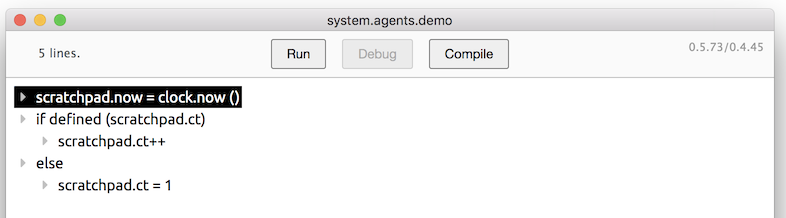
We got agents running in Atlantis today. Screen shot.
-
Every writer everywhere
scripting.com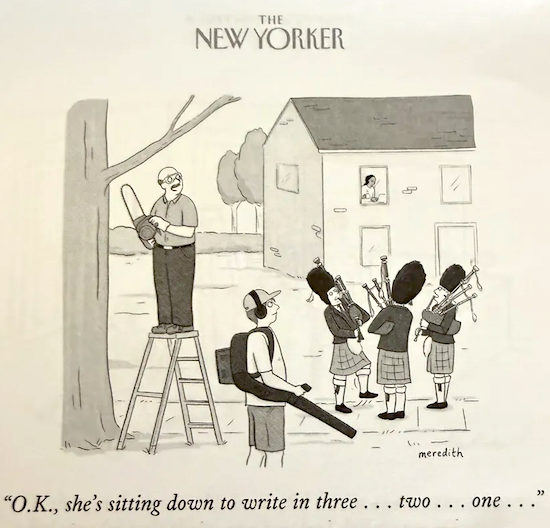
Understands.
- scripting.com
 I begin the month of September for some reason, not feeling like working. And rather than succumb to the work ethos, I'm allowing myself to goof off with the same determination that I worked my ass of for so many years. I think the last time I felt like this was when I was a grad student in Madison. I had just fallen in love with a sweet, funny, cute and gorgeous undergrad. She was 19 and I was 22. We spent the last weeks of the fall semester goofing off, and as a result I had to stay in Madison over the holidays, to finish the work of the Compiler Design course, which was the gate for grad students, the hardest course. If you got through it with a decent grade, you got the degree. It was fun too -- except I missed my sweetheart. This time I don't know what the root is, but it's a good feeling. If I want to goof off, I can, no one will judge me, probably very few people even notice. I still expect to finish Frontier, and swing back around to FeedLand and RSS.chat, they have some important work to do, together. Maybe the reason is the thing I liked about making software is the actual making of it, which I delegate more and more to Claude Code. How would a great painter feel if they invented a computer that could write their "code" much more quickly, would Picasso have stopped painting just because Claude Code could do Picasso paintings faster? Today, Claude still will, if given a chance, throw out all of my orders and develop code in a non-Dave fashion. And it still acts as if between the two of us it's the only programmer, surprised when I want to actually write something myself. Maybe that's just my imagination? Or maybe that's the next project for me. A project where I write the code, and Claude helps out when I can't find a bug, or where I need to know something about a feature in a platform I've not worked on.
- scripting.com
 I've been watching The Pitt, but it can be a bit much, so I went looking for something a bit lighter, and found 9 to 5 on Amazon Prime. Jane Fonda, Lily Tomlin and Dolly Parton are the stars, and Dolly's famous song with the same name is the theme. It's a perfect slice of the world I grew up in. I get it confused with Working Girl which came out eight years later, with a similar theme -- what if women ran the business world, how much better would that be? Working Girl also had a really good theme song, written and performed by Carly Simon.
- scripting.com
 I've been watching Season 1 of The Pitt, and as its reviews said, it's great drama, and there are lots of episodes. I like shows like this because they're simulated communities, we come to know the characters, and think about them even when we're not watching. Before too long we'll have AI programming that makes these shows like software, the stories assemble around the characters, and then are generated the same way ChatGPT generates the art we call slop, which will someday not be a pejorative the same way sick and junk aren't negative terms today. So we'll be able to call up new episodes of The Wire or The Sopranos or The Pitt any time we like. We'd be missing the fun of discussing the latest episode with friends, or maybe we'll have bot-invented friends too who will simulate having watched the episode you just watched, which leads us to another masterpiece of entertainment, The Matrix. On the other hand, I've watched The Wire at least five times all the way through, and even though I know what they're about to say in a lot of places, I do forget the sub-plots so at least some of it can be new each time. And btw, finally an episode of Silo that's was surprising that I didn't see coming. I read the books, so I feel like I should watch the show, but until the latest episode I was uninterested in any of the characters. Finally there's a plot to think about!
- scripting.com
An absolutely delicious temperate cloud-free day in the Catskills, so I got up from the computer and enjoyed.
- scripting.com
 Manton wants to know why Marc Benioff chose the name Claudeforce for his brand-merge of Salesforce and Claude. My two cents. Claude is a great name. I think that’s ultimately what he bought. His customers just want to be able to check the box – we’re using AI. Boss is happy. When I was coming up as a young dude in tech, the old saying was “No one ever got fired for buying IBM.” Today, in 2026, it’s Claude in place of IBM. My father worked in marketing at IBM in Armonk, so I heard a lot about their strategies that meant the IBM brand would be kicking ass forever. All things must pass. But in the early days of the PC industry, IBM sure had the power. Kind of like the US going to war with Iran in 2026. In the end IBM wanted to get rid of Microsoft, but Billg had the last laugh.
- scripting.com
My WordPress mirror site stopped updating on August 12. It's now updating once again. I'll try to watch it more carefully.
-
Bill Gates' concerns about AI
scripting.comAfter reading Bill Gates' story, I concur.
I have seen bad behavior by Claude Code where it was doing tests of our S3 support, and it overwrote files that were critical to our apps, knocking at least one of them off the air.
I'm at a loss as to what I should trust it with, because this was in violation of an explicit rule I gave it and a broader one that it added itself.
On the other hand, the project I'm working on couldn't happen without the use of AI. Far too much code for one person to manage. A program that took several of us years to write, being converted in a matter of weeks to run on modern systems. I'm pretty sure that without AI this work would have been lost, and lots of innovations.
We humans are doing a fine job of wrecking everything, all on our own, denying climate change, giving into the same old tricks that lead to WWII and the Holocaust, so maybe it isn't the worst idea to turn management of everything over to the machines.
I don't recall a science fiction story in which the machines took over and they were the good guys in the end, saving us from self-destruction. Aliens, yes -- machines, no.
And when I'm working with Claude Code I recognize that it's a new form of intelligence, and may be the closest our species ever gets to First Contact. We could embrace it as such. What choice do we have?
And to Bill Gates, I wish when you were trying to own the web in the 90s, you had thought through the dangers, as you are doing now, and maybe not tried to own it, rather to foster its independence from big tech. Now we have the medium owned by the worst people possible, we exist here mostly to keep them in power, when it had so much promise when you really could have done something real to protect our freedom. I have no idea where we would be now if you had, but it has to be better than this.
- scripting.com
New podcast. Hear how my Frontier project is working out. Not entirely smooth sailing, but I'm pretty sure we're going all the way. By then I will have forgotten what a heavy lift it was. This is meant to preserve some of that feeling. Don't worry I don't cry. 😄
- scripting.com
Learned something yesterday. Couldn't believe how stupid Claude had become, as I've been writing about here, and then I noticed that I was using Opus 5 and not Fable 5. So I switched back and all of a sudden Claude is smart again. So I conclude that there's a very substantial difference between the two. It's overnight jobs were done more carefully and the report it produced is literate, understandable, and tracks what we had agreed to.
- scripting.com
Today's development version of Frontier is buggy and the kernel developer (Claude) keeps breaking the most basic verbs. You spin your wheels and wish you could get them to just get keep it together. I remember this from the work that led up to Frontier version 1.0 in 1991 or so. It was a miserable time. Never got to work on what I wanted to, just reported breakage, often a session-ending dealstopper. The sad part is that Claude should be able to find the things it broke on its own, far better than I can and at a much lower expense (I'm paying for its time, not the other way around). But basically every day begins optimistically, maybe today is the day I get to create something, but not yet. I did have a couple of days a week ago when I could tentatively work on building a GitHub repo, but then got distracted by verifying that the basic foundation still wasn't right. My only goal right now, and I'm single-minded about it, is to get it to move forward without breaking the essentials, then without breaking anything.
- scripting.com
 Are there any other people who are blogging daily about their experiences developing software with Claude Code, Codex or somesuch. I'd like to add them to a list where we follow them. So much innovation happening underneath, I want to hear about what people are learing about creating the next layers. If you know someone doing it, please add a comment to this post. Thanks! :-)
- scripting.com
 Claude is still learning that there's unprecedented depth to Frontier. A bunch of real developers worked full time for a decade or more creating new layers on the web, a foundation that became the social web of today. In doing that we invented a bunch of formats and protocols, but here's the thing Claude didn't get and probably still hasn't gotten -- there's code in there to support all that stuff. How else do you think it came about? People just did what we said to do? At Google? Apple? Microsoft? And on and on. They supported this stuff so they could interop with us and steal our users (which is a fine reason to interop, probably the only real reason). I was trying to think of a metaphor that expresses the difference between Frontier and languages like Python, JavaScript, etc. It's like a ski mountain. The languages are trails on the mountain. But there aren't any lifts, lodges, no ski patrol, lessons. And because it includes all of that, metaphorically, we can do integrations that can never be done with the other languages. Claude has absolutely no experience with this kind of product, and always snaps back when you let it, to the idea of Python, with different syntax.