Timeline
Every post and feed across this instance
-
Bonus: What the Wagner Mutiny Means for Putin’s Grip on Power and the Ukraine War
Former Director of Global Engagement in the Obama White House, Brett Bruen hosts our weekly special One More Decision with Sir Richard Dearlove for analysis on Wagner group leader Yevgeny Prigozhin's short-lived coup against Russia and exile to Belarus. Sir Richard shares his views on the aftermath, and what this means for Russian President Vladimir Putin's grip on power and the war in Ukraine. Learn more about your ad choices. Visit megaphone.fm/adchoicespdrl.fm -
Bonus: What’s Behind the Coup in Niger?
Last week’s coup in Niger is the latest in a string of recent military takeovers in Africa—seemingly the final domino to fall in a region plagued by instability and the battle between Russia and the West for influence in the Sahel. Coup leaders are now facing an ultimatum from the Economic Community of West African States (ECOWAS) to reinstate democratically elected President Mohamed Bazoum or face the consequences including possible military intervention. On this week’s bonus episode, Julia Macfarlane asks her co-host Sir Richard Dearlove what he’s hearing from the French intelligence community about what’s behind the rebellion and if there’s any truth to reports about the Kremlin’s involvement. Learn more about your ad choices. Visit megaphone.fm/adchoicespdrl.fm -
A Year of Decisions: Our First Anniversary Episode
The former head of MI6 does not often take questions from the public. To mark One Decision’s first year, Sir Richard Dearlove agreed to take a few submitted by our listeners via social media and the web site. He provides analysis, intrigue and his behind-the-scenes insights on the issues that are on the top of your minds. We look back at pivotal points in recent history like the Iraq War and the role that intelligence played in the West’s decision to go to war. We look ahead to what China is likely to do on Taiwan. We look around at how the world is responding to the threats of climate change, changing demographics, and our polarizing political environment. This is a truly unique episode created by our audience across the globe. Learn more about your ad choices. Visit megaphone.fm/adchoicespdrl.fm -
A Year of War - 2024 May Be Worse…
What decision had the most international impact in 2023? The war in Ukraine continued to loom large among Western nations’ foreign policy priorities. The sudden, shocking resurgence of war in the Middle East quickly dominated the global agenda, raised questions about how long the Israeli-Hamas conflict could drag on and whether peace there can even be achieved. One Decision's annual roundtable of top world affairs reporters takes stock of 2023 and what big decisions are coming up next year. One major moment the whole world will be watching is the outcome of the United States presidential elections, which could potentially see the return of Donald Trump to the White House. Host Julia Macfarlane is joined by The Independent's Bel Trew, Semafor's Prashant Rao, and Foreign Policy's Robbie Gramer. Learn more about your ad choices. Visit megaphone.fm/adchoicespdrl.fm -
Bonus: How Bad is the Democratic Damage in Israel?
Protests have picked up in Israel this week as the Knesset takes up the controversial legislation proposed by Prime Minister Benjamin Netanyahu that critics say would compromise the integrity and independence of Israel’s judicial system. If passed, the measure would eliminate the so-called "reasonableness clause" and would permit the judiciary to put curbs on government decisions granting Netanyahu and his coalition unfettered powers. One Decision's Julia Macfarlane speaks to journalist Noga Tarnopolsky from Jerusalem for an update on what's happening on the ground and the state of US-Israeli relations after President Joe Biden criticized the judicial overhaul plan. Learn more about your ad choices. Visit megaphone.fm/adchoicespdrl.fm -
What Went Wrong? Ex-Head of MI6 on the Attacks and Israeli Intelligence
The world is still reeling from the shocking invasion of Israel over the weekend, where Hamas militants staged the most audacious and horrific attacks in Israel resulting in the biggest loss of Jewish life since the Holocaust. But questions are now being asked, to how the country's high tech military and sophisticated intelligence services missed what Hamas was planning? Did Mossad drop the ball? What responsibility belongs to Israeli Prime Minister Benjamin Netanyahu? One Decision's Sir Richard Dearlove, the former Chief of MI6, examines the issues that may have impacted Israeli intelligence agencies' ability to anticipate the worst attack in the state's history. Learn more about your ad choices. Visit megaphone.fm/adchoicespdrl.fm -
Eastern European Leaders on the Russian Risks
In this bonus episode, One Decision's Christina Ruffini sits down with the Czech Republic's Foreign Minister, Jan Lipavsky, and Poland's Ambassador to the United Nations, Krzysztof Szczerski, in New York City during the United Nations General Assembly. They discuss Russia's military threat in Eastern Europe, the strain of illegal migration, international support for Ukraine, and the role of multilateralism in a changing world. Learn more about your ad choices. Visit megaphone.fm/adchoicespdrl.fm -
How Dangerous is a Second Trump Term? We Ask a Fellow Candidate
One Decision sits down with Republican presidential candidate Asa Hutchinson, the former governor of Arkansas to talk about America’s foreign policy priorities and what should be done about China. Hutchinson is an outsider in the race, but insists he is there to widen the parameters of the debate, as Trump and DeSantis continue to offer a populist, nativist vision of America to voters. And, Sir Richard Dearlove reacts to the unsealing of the criminal indictment against former President Trump, as the world learns what exactly was sitting in the rooms at Mar-a-Lago before the FBI carried out raids to retrieve the highly classified intelligence Trump was hoarding nearly a year ago. Learn more about your ad choices. Visit megaphone.fm/adchoicespdrl.fm -
Nothing is Safe. Have a Nice Day.
Governments around the world can now slip into your DM’s—and everything else—unnoticed. A team of journalists vows to expose it all. Listen to Laurent Richard and Danna Ingleton on the NSO Group. Learn more about your ad choices. Visit megaphone.fm/adchoicespdrl.fm -
Ex-US Diplomat on His Time in Moscow, Ukraine, & Putin's Next Move
In this week's episode of One Decision, hosts Christina Ruffini and Leon Panetta, former United States Secretary of Defense and former CIA Director, sit down with Ambassador John Sullivan. Sullivan is a former Deputy Secretary of State and served as U.S. Ambassador to Russia during the Trump and Biden presidential administrations. They discuss the reality of navigating diplomatic relations with Russia, Sullivan's experience in Moscow at the start of the war in Ukraine, and what the fall of the Syrian Assad regime could mean for Putin's grip on power. Plus, Sullivan and Panetta share an insider view of how foreign diplomats navigate life in Russia and the number one thing a spy needs to do to protect themselves under the Kremlin's watchful eye. Learn more about your ad choices. Visit megaphone.fm/adchoicespdrl.fm -
What Would Victory Look Like for Putin?
As the second anniversary of Russia's invasion of Ukraine approaches, and United States support to arm Ukraine fades, One Decision's Sir Richard Dearlove and guest host Jane Ferguson talk to renowned Russia expert Dr. Fiona Hill about what's inside Russian President Vladimir Putin's playbook and how the conflict might ultimately end. Dr. Hill served as a top national security advisor to three American administrations - including famously as the leading White House official on Russia for President Donald Trump. She discusses what victory would look like for Putin, the implications of a Trump return as commander-in-chief. Learn more about your ad choices. Visit megaphone.fm/adchoicespdrl.fm -
How the World Got Owned Episode 2: The 1990s, Part One
In this special documentary episode, Patrick Gray and Amberleigh Jack take a look back at hacking throughout the 1990s, from the feel-good vibes of the early hacking communities to the antics of young hackers who wound up on the run from the FBI.
Part one features recollections from:
- Jeff Moss (The Dark Tangent), DefCon and Black Hat founder
- Chris Wysopal (Weld Pond), L0pht member, co-founder, @Stake
- Kevin Poulsen (Dark Dante), 1990s hacker turned journalist
- Elias Levy (Aleph One), author of Smashing the Stack for Fun and Profit, Phrack, 1996
How the World Got Owned is produced in partnership with SentinelOne.
Show notes
- Elias Levy (Aleph1), Former Principle Engineer, Google
- Kevin Poulsen, Journalist
- Jeff Moss, DefCon founder
- Chris Wysopal, @Stake founder, L0pht member
- Hackers testifying at the United States Senate, May 19, 1998
- Hackers May ‘Net’ Good PR for Studio
- DefCon Archives | DefCon 1
- A Not So Terribly Brief History of the Electronic Frontier Foundation
- Innocent Hackers Want Their Computers Back
- Breakdowns in Computer Security
- Unsolved Mysteries, Season 3, Episode 4
- The Last Hacker: He Called Himself Dark Dante. His Compulsion Led Him to Secret Files and, Eventually, The Bar of Justice
- Justia appeal summary, Kevin Poulsen, 1994
- Smashing the Stack for Fun and Profit, Phrack Magazine, November 1996
- From subversives to CEOs: How radical hackers built today’s cybersecurity industry
dts.podtrac.com -
People and Blogs: Anthony Nelzin-Santos
People and Blogs is a series by Manuel Moreale featuring the people behind personal blogs and the stories of their corners of the web. This conversation is with Anthony Nelzin-Santos. Do go visit thei... -
12-month Inoreader Pro for $75US
Looking to sell the remainder of my Inoreader subscription. Expires on May 17, 2027. DM me for details. I'll simply replace my email with your email address, ensure confirmation and send a reset password.
Happy to answer any questions or provide screenshots.
submitted by /u/adtdePhi
[link] [comments] -
Speaking of RSS, Marc Weidenbaum is using FeedLand and GitHub to curate an OPML file of electronic music feeds: https://disquiet.com/2026/07/31/electronic-music-rss-starter-kit/
-
Claude, we need to fix the default markdown style sheet for pagepark.
https://news.rss.chat/blogroll/readme.md
This can be quickly fixed with one of the public domain style sheets.
-
MLM ou arnaque pyramidale ? 4/4, avec Manon Lasne — SHOCKING #31
Chapitre 4 : Épuisement et désillusion. Malmenée par un système auquel elle veut pourtant croire, Manon nous raconte comment elle persiste et signe en entrant chez une troisième société de marketing de réseau. Jusqu’où ira-t-elle dans son engageme... -
Linkception
So many links in one post. I ended up going down all kinds of rabbit holes off the back of this single post (also the second time I've linked to Sal's blog today 🙃).
I discovered Coyote's blog, and Sylvia's. So went ahead and read some of their posts. I was already aware of Brennan's fantastic blog, but it's a great read, so check it out.
Anyway, I completely agree with what Sal, Coyote, and Brennan say in their posts - the backbone of the internet is the hyperlink, so go forth and link out to your fellow bloggers with reckless abandon.
It's what makes the web, the web. 🕸️
Thanks for reading this post via RSS. RSS is ace, and so are you. ❤️
You can reply to this post by email, or leave a comment.
-
Stateless MCP has recaptured my interest (and inspired mcp-explorer and datasette-mcp)
Tuesday was Stateless MCP day - the rollout of MCP 2.0, or the 2026-07-28 Model Context Protocol specification to use the more formal but less memorable name. This is the most significant change to the MCP spec since it first launched, and has also served to reignite my personal interest in the protocol.
For background: MCP is the Model Context Protocol, which describes a standard way to expose new tools to LLM-powered agent frameworks. It was introduced by Anthropic back in November 2024, had a huge spike of interest through much of 2025, and then became somewhat eclipsed by Skills (another Anthropic invention) when it became apparent that an agent harness with access to a terminal and
curlcould do most of what MCP did in a more flexible way. I wrote about that in my review of 2025.I'm coming back around to MCP now. Giving an agent a shell environment with the ability to access the internet is fraught with risk, and requires a strong model that is capable of effectively driving such an environment. MCP tools are easier to audit and control, and simple enough that smaller models that run on a laptop can still drive them reasonably well.
The new stateless MCP specification also greatly decreases the complexity of implementing both clients and servers for the protocol. I built three of those this week!
What's easier with stateless MCP
The best demonstration of the difference between stateful and stateless MCP is in this May 21st blog post that introduced the RC for the new specification. It included a clear before-and-after example.
The older stateful MCP (I'm going to call it "legacy MCP") required two HTTP requests - the first to initialize a session and obtain a
Mcp-Session-Id, and the second to actually call the tool:POST /mcp HTTP/1.1 Content-Type: application/json { "jsonrpc": "2.0", "id": 1, "method": "initialize", "params": { "protocolVersion": "2025-11-25", "capabilities": { }, "clientInfo": { "name": "my-app", "version": "1.0" } } } POST /mcp HTTP/1.1 Mcp-Session-Id: 1868a90c-3a3f-4f5b Content-Type: application/json { "jsonrpc": "2.0", "id": 2, "method": "tools/call", "params": { "name": "search", "arguments": { "q": "otters" } } }The new stateless way uses a single HTTP request which looks like this:
POST /mcp HTTP/1.1
MCP-Protocol-Version: 2026-07-28
Mcp-Method: tools/call
Mcp-Name: search
Content-Type: application/json

{
  "jsonrpc": "2.0",
  "id": 1,
  "method": "tools/call",
  "params": {
    "name": "search",
    "arguments": {
      "q": "otters"
    },
    "_meta": {
      "io.modelcontextprotocol/clientInfo": {
        "name": "my-app",
        "version": "1.0"
      }
    }
  }
}
This is so much cleaner from both a client- and server-side implementation perspective. It's also a better fit for building scalable web applications, since now you don't need to maintain server-side state to keep track of those session IDs, or worry about routing the same session to the same backend machine.
mcp-explorer
I couldn't find a great CLI tool for interactively probing an MCP server, so I had Codex help build my own.
mcp-explorer is the result. It's a stateless Python CLI tool, so you don't even need to install it to try it out - it works with uvx like this:
uvx mcp-explorer list https://agentic-mermaid.dev/mcp
This queries Ade Oshineye's agentic-mermaid.dev demo MCP. The above command returns the following list of tools:
execute(code: string, timeoutMs?: integer) - Execute Mermaid SDK code
  Run JavaScript in an isolated sandbox; return a value.

describe_sdk(family: string, detail?: string) - Describe Mermaid SDK operations
  Return version-matched mutation operations for one diagram family.

render_svg(source: string, options?: object) - Render Mermaid as SVG
  Render a Mermaid source string to themeable SVG. Returns { ok, svg }.

render_ascii(source: string, useAscii?: boolean, targetWidth?: integer, options?: object) - Render Mermaid as text
  Render a Mermaid source string to text. Returns { ok, text }.

render_png(source: string, scale?: number, background?: string, fitTo?: object, options?: object) - Render Mermaid as PNG
  Rasterize a Mermaid source string to PNG. Returns { ok, png_base64 }.
...
Then to inspect a tool:
uvx mcp-explorer inspect render_svg
This outputs a whole bunch of information, including the JSON schema of the inputs and outputs.
To call that tool and pass arguments to it:
uvx mcp-explorer call \
  https://agentic-mermaid.dev/mcp \
  render_svg \
  -a source 'graph TD; A-->B' \
  -a options '{"padding":24}'
Which returns:
{"ok":true,"svg":"<svg xmlns=\"http://www.w3.org/2000/svg\" width=...To get just the raw SVG try adding
| jq .svg -rto that command. I got back this image: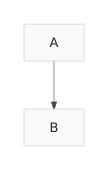
There are a few more commands in the README, but you get the general idea. I find building CLI tools like this to be a really productive way to get familiar with a specification, even if an agent writes most of the actual code.
datasette-mcp
The second project is datasette-mcp, a Datasette plugin which adds a
/-/mcpendpoint to any Datasette instance.This is probably the fourth time I've tried building this plugin, but thanks to the new stateless MCP specification I finally have a version that feels good to release.
It provides just three tools:
list_databases(),get_database_schema(database_name), andexecute_sql(database_name, sql). They do exactly what you would expect them to do - thoughexecute_sql()is read-only for the moment.Wire these into an agent, or a chat tool like ChatGPT or Claude, and they'll gain the ability to run SQL queries against your hosted Datasette instance.
So far I'm running it on the Datasette mirror of my blog, at datasette.simonwillison.net/-/mcp. It took a bit of fiddling to figure out how to attach that to ChatGPT and Claude, but I got there in the end. Here's a new TIL showing exactly how to do that.
Here's a shared Claude session where I asked it:
list tables in simonwillison.netAnd then:
what has Simon said recently about MCP?It ran 7 separate SQL queries to figure out the answer.
llm-mcp-client
My LLM tool is long overdue for an official MCP integration. The new alpha llm-mcp-client plugin is my attempt at exactly that:
llm install llm-mcp-client
llm -T 'MCP("https://datasette.simonwillison.net/-/mcp")' 'count the notes'
Here's the output (including reasoning trace, I'm using LLM 0.32rc2):
Considering note count
I see the question "count the notes" is probably asking me to tally up blog notes. It could also mean published notes or drafts, so there's some ambiguity there. I'll need to figure out the total number of notes, likely by querying the count for both published notes and drafts to get a clear answer. Let's execute that count!
There are 151 notes.
And the output of llm logs for that prompt.
Once this is fully baked, I'm considering bringing it directly into LLM core. I'm excited to experiment with MCP in Datasette Agent and llm-coding-agent as well.
MCP is a safer way to build with agents
A few months after MCP was first released, I wrote Model Context Protocol has prompt injection security problems, where I noted that the pattern of having end users mix and match tools pushed responsibility for avoiding data exfiltration attacks out to the users themselves. I hadn't coined the Lethal Trifecta yet, but that was absolutely what I had in mind.
Then general agents with arbitrary shell and
curlaccess came along, and that's so much harder to keep secure!Something I've come to appreciate about MCP is that it's much easier to reason about agent capabilities and what might go wrong than with arbitrary command execution in an open network environment - the default for most of today's general and coding agent tools.
I plan to lean into MCP a whole lot more when I'm building sensitive applications on top of LLMs.
You are only seeing the long-form articles from my blog. Subscribe to /atom/everything/ to get all of my posts, or take a look at my other subscription options.
-
Daily Deal: The Lifetime Learner Bundle
The Lifetime Learner Bundle feature access to uTalk and Stack Skills. Through uTalk, you’ll be able to speak keywords and phrases in no time and will start to see the results straight away. You can pick 6 languages to learn from their library of 140+ languages. You also get access to Stack Skills, the premier […] -
Federal Judges Chastise Trump’s Justice Department For “Unlawful,” “Unethical” And “Unseemly” Conduct
This story was originally published by ProPublica. Republished under a CC BY-NC-ND 3.0 license. Across the country, federal judges are calling out Department of Justice lawyers, questioning in unprecedented ways whether they can be trusted to tell the truth or uphold centuries-old legal norms. From Washington, D.C., to Rhode Island to Oregon, federal judges nominated by presidents from both parties, […] -
Ctrl-Alt-Speech: Zuck Starts Throwing His Weights Around
Ctrl-Alt-Speech is a weekly podcast about the latest news in online speech, from Mike Masnick and Everything in Moderation‘s Ben Whitelaw. Subscribe now on Apple Podcasts, Overcast, Spotify, Pocket Casts, YouTube, or your podcast app of choice — or go straight to the RSS feed. To get extended episodes with additional coverage, support us on […] -
What Ukraine’s Battlefield Openness Can Teach Washington About AI Access
On a laptop screen in a dimly lit tent near the Donetsk front, a Ukrainian drone team steers its aircraft into the turret of a Russian T-72 and glimpses the start of an explosion before the picture dissolves into static. The strike is uploaded, verified, and scored against the point value assigned to the tank. […] -
The Furious Minds of the MAGA Right (with Laura Field)
Join Samantha and guest Laura Field, author of the new book *Furious Minds*, as they discuss how ideas have driven history, from John Maynard Keynes to Abraham Lincoln to Project 2025. How did highly online right-wing weirdos become "the brain trust and influencer arm" of the Republican Party? What sects and factions are operating beneath the surface? And how do they marry grandiose philosophy, gutter racism, and relentless posting to rise to power?
*Furious Minds: The Making of the MAGA New Right*: https://bookshop.org/a/115699/9780691255262
anchor.fm -
Politics As Culture (with W. David Marx)
Has culture stagnated in the 21st century? Do the last twenty-five years feel like a blur? What can politics learn from the inherent dynamics of cultural change? And is Donald Trump the greatest kitsch artist of our time? Join Samantha Hancox-Li and guest W. David Marx, author of the just-released *Blank Space*, as they talk all of this and more.
And if you like what we're doing here at Liberal Currents, consider supporting our fundraiser so we can continue our mission of reinvigorating liberal culture and politics: https://www.gofundme.com/f/the-liberal-currents-startup-fund
*Blank Space*: https://bookshop.org/a/115699/9780593833995
anchor.fm -
The Porn Brain of the New Right
Content warning: rape, pedophilia, and historical atrocities.
Join Samantha and guest Alan Elrod as they talk about the role of rape in conservative ideology, biopolitics as the Rosetta Stone of authoritarian reaction, and the pornographic fantasies that pervade the new right. Alan is the president and CEO of the Pulaski Institution, as well as a contributing editor at Liberal Currents.
Links to essays on the subject from Alan and Samantha:
https://www.liberalcurrents.com/guys-win-andrew-tate-rape-politics-and-the-authoritarian-right/
https://www.liberalcurrents.com/the-new-gender-synthesis/
anchor.fm -
The Ongoing Immigration Crisis
Join Samantha and guest Dara Lind, Senior Fellow at the American Immigration Council and former immigration reporter for Vox and ProPublica, as they talk the state of Trump's mass deportation program, the question of its constitutionality, and the bigger question of how immigration in America became such a nightmare—and what we can do about it.
anchor.fm -
Immigration Is Good, Actually
Trump II is upon us, and the administration has already taken aim to reduce citizenship rights and deport immigrants, despite the longstanding truth that arguments against immigration don't hold much water. Liberal Currents associate editor Paul Crider joins Samantha and Jason to describe the new Republican restrictionism and to give some of those arguments another drubbing.
anchor.fm -
Immigration and Terror
Amidst escalating ICE raids, lawless deportations, and the horror of CECOT, immigration has moved to the center of American politics. Join Samantha and guest Adam Gurri, editor-in-chief of Liberal Currents, as we talk about the ground truth: policing immigrants requires restricting the freedoms of citizens. Authoritarianism for the out-group inevitably trends towards authoritarianism for the in-group. Chandran Kukathas was right all along.
Read Adam's essay on the subject here: https://www.liberalcurrents.com/the-totalitarian-logic-of-immigration-controls/
anchor.fm -
The Inner Philosophy of the Far Right
The reactionary right is in ascendance in the Trump administration. It's easy to dismiss them as a cabal of incoherent fools scrambling for Trump's ear. But there is a deeper philosophy animating their political project: one based on a longing for an imagined aristocratic past, a craving for hierarchy and certainty, and simultaneously a deeply ambivalent relation to modernity. Samantha is joined by political theorist Professor Matt McManus for a discussion of his recent essay, "The Far Right Canon."
https://www.liberalcurrents.com/the-far-right-canon/#/portal/signup
anchor.fm -
The Authoritarian Logic of Child Abuse
Join Samantha and guest Talia Lavin, author of Culture Warlords and Wild Faith, as they discuss Donald Trump's connections with Jeffrey Epstein, the broader problem of child sexual abuse among Republicans, and how this connects with their vision of a family and a nation dominated by authoritarian, unaccountable fathers. As they say on the internet: pedocon theory is a theory like gravity is a theory.
anchor.fm -
What Is Liberal Currents?
People find us hard to categorize: are we emphatic liberals? Radical leftists? Crypto-libertarian infiltrators? Join Samantha and Liberal Currents editor-in-chief Adam Gurri as they discuss what it means to be a home for mere liberalism, the foundational principles of the liberal project, and how to be a liberal who means it in our time of crisis.
anchor.fm -
Canada Fights Back (with John Banks)
Samantha and essayist John Banks discuss what steps Canada is taking to fight back against Trump's aggression. Mark Carney's "variable geometry" Davos speech, the dilemmas facing middle powers, and the future of liberal internationalism are covered. In Banks' view, the Republican Party has adopted the ideology of a continental "civilization-state," and as long as they remain a political force in America, Canadian-American relations will never again be quite so friendly.
anchor.fm -
What Just Happened?
Samantha and Jason dissect and reject several popular theories of why Harris lost. They also speculate about what to expect from the next Trump administration: tariffs, mass deportation, and Gorilla Channel Governance.
anchor.fm -
Knowing the Question Is Half the Answer
Samantha and fellow Liberal Currents editors Caitlin Green and Trent Nelson talk the crisis of misinformation, taking responsibility for your own beliefs in the social media age, and their new podcast, Half the Answer.
anchor.fm -
An Unsettled Age
The future of the world order is more uncertain than it has been since the fall of the Soviet Union—which is to say, up for grabs. Join Samantha and guest Joe Stieb, assistant professor at UNC Chapel Hill and historian of American foreign policy, as they discuss how the world order has changed since 1989, the decay of liberal internationalism in favor of American unilateralism, and the alarming growth of what Stieb calls the "authoritarian internationale."
anchor.fm -
A New Reconstruction?
Samantha and guest Jamelle Bouie talk the present crisis, the many ages of the American Constitution, and how we might set about rebuilding what MAGA is breaking.
anchor.fm -
The State of the Union (with Jamelle Bouie)
Samantha and returning guest Jamelle Bouie take a step back and assess the overall arc of the Trump Administration. Bouie argues that Trump's theory of the case when he came into office was fundamentally based on speed: move fast, break things, and present American society with strongman rule as a fait accompli.
But instead of producing compliance and popularity, Trump's authoritarian policies have produced increasing backlash from numerous sectors of society. Now we see a presidency adrift, out of ideas and trapped in its own echo chamber. What comes next?
anchor.fm -
The Border Crisis Is an Everything Crisis
Join Samantha and guest Professor Anna Law as they talk about the exploding constitutional crisis over Donald Trump's deportation program, exemplified by the removal of Kilmar Abrego Garcia. Along the way they address the importance of due process, the Fugitive Slave Crisis and the origins of birthright citizenship, and the meaning of American citizenship in the twenty-first century.
References:
"The Present Crisis and the End of the Long '90s": https://www.liberalcurrents.com/the-present-crisis-and-the-end-of-the-long-90s/
Professor Law's website: https://www.annaolaw.com/
Corrigendum: Professor Law adds, "I made a factual error. The 100 mile zone is only along the nation’s land borders not the airports. BUT, as this CNN article states, 'Two-thirds of the US lives inside this so-called 100-mile border zone, which includes several entire states, including Florida, Michigan, Maine and Hawaii, according to the American Civil Liberties Union.'" https://www.cnn.com/2018/05/23/us/border-zone-immigration-checks/index.html
anchor.fm -
Venezuela and the State of American Strategy (with Giselle Donnelly)
Join Samantha and Giselle Donnelly, foreign policy analyst and American Enterprise Institute alumna, as they discuss the recent attack on Venezuela. Does this reflect a considered strategy? Or multiple factions "working towards the sleepy Führer"? Can we make predictions about future American foreign policy, or is it all just chaos?
anchor.fm -
Liberal...Socialism?
Samantha and fellow Liberal Currents editor Paul Crider talk to Matt McManus, author of The Political Theory of Liberal Socialism, about a forgotten political tradition, the intellectual fallout of the Russian Revolution, and what this all means for how we think about the contemporary dangers of oligarchy and reaction.
anchor.fm -
Has Feminism Run Out of Steam?
Join Samantha and guest Talia Bhatt as they discuss the state of feminism under Trump II, the enduring relevance of radical feminist ideas, and the uses and abuses of intersectionality in contemporary leftist thought.
anchor.fm -
Liberalism 101: Liberalism and Enlightenment
Are you sad? Lonely? Can't get a girlfriend? The reactionary right promises a total philosophy of life—not just a politics, but a comprehensive way of living (and explaining why it's all the libs' fault). Can liberalism speak to the same anxieties?
Host Samantha Hancox-Li argues that it can, but to understand why, we need to return to the roots of liberalism in the Scientific Revolution, the Enlightenment, and ultimately the ideas of freedom, reason, and responsibility.
anchor.fm -
Liberalism 101: Liberalism and Prosperity
Samantha and fellow Liberal Currents editor Jason Briggeman discuss the economics of liberal democracy, starting from the basic question "why are all the rich countries liberal democracies?" Did liberal democracy cause the Industrial Revolution? What is the role of imperialism in the modern economy? And perhaps most importantly: what does this have to do with the philosophical foundations of liberalism?
anchor.fm -
Will Political Violence Save Us?
Samantha and Jason talk about ghost guns, CEO killings, and the place of political violence in the repertoire of contention.
anchor.fm -
The Meme Politics of "Hearts of Iron"
Join host Samantha Hancox-Li as she explores the concept of "meme politics," which pervades the current Trump II administration, through the historical grand strategy game Hearts of Iron IV. In reality, society is an obscure, complicated, recalcitrant system. Meme politics asks: what if it wasn't? What if everything was simple, direct, and easy? By understanding this popular historical simulation game, we can better understand why the reactionary right approaches policy in such an ineffective way. Plus, you get to watch Samantha conquer China by 1938.
anchor.fm -
Can Populism Save Democracy?
Join Samantha and Jason as they discuss the resurgence of economic populism, the breakdown of the dreaded "neoliberal consensus," and whether populism itself is just a vibe.
anchor.fm -
Liberalism 101: Liberalism and Toleration
Samantha and Lucian Staiano-Daniels, author of "The War People," discuss the connection between liberalism and toleration and the dark history of religious civil war. How did the European Wars of Religion give birth to our concept of toleration? And is this history enough reason today to embrace toleration? Can religious civil wars be won—or is there a deeper reason to want to live in a diverse and pluralist society?
anchor.fm -
Are Liberals Losing the Culture War?
Andrew Breitbart argued long ago that "politics is downstream of culture." Is that true? Is there such a thing as liberal culture? Has Trump II revealed its apparent dominance to be hollow? Or is the death of liberalism overwrought? Join Samantha and guest Alex Lefebvre, author of Liberalism As a Way of Life, as they discuss these issues and more.
anchor.fm -
The Future of Feminism
There's a lot of gender happening these days—and feminism, the political movement that ought to be at the forefront of responding to the MAGA backlash, is in its wilderness years. Join Samantha and guest Jude Doyle, author of the forthcoming book DILF, for a wide-ranging conversation about the history of the third wave, the meaning of patriarchy, and why a renewed focus on bodily autonomy and self-determination for all people needs to be the focus of feminism going forward.
DILF book link: https://bookshop.org/a/115699/9781685892159
anchor.fm